-
E-mail
3495811982@qq.com
-
Phone
13619217766
-
Address
No. 3 Xingzhong Road, Lianhu District, Xi'an, China
Xi'an Kaixin Biotechnology Co., Ltd
Collection! Chemical Properties and Reaction Mechanism of Boc PEG Hydroxysuccinimide
Date: 2025-12-22Read: 0
·Chemical composition and structure
NHS active ester end: This is a highly reactive functional group that can efficiently react with primary amino groups (- NH ₂) on the surface of proteins, peptides, antibodies, or other molecules under pH 7-9 buffer conditions, forming stable amide bonds. This is the basis for its coupling.
Boc protected amino end: The terminal amino end is protected by tert butoxycarbonyl (Boc). This protective group can be specifically removed under mild acidic conditions, exposing a free primary amino group (- NH ₂). This newly exposed amino group can be used for the subsequent second step chemical reaction.
PEG Chain: The middle polyethylene glycol chain not only enhances the water solubility and biocompatibility of the entire molecule, but also acts as a flexible spacer arm, reducing steric hindrance during the reaction at both ends and helping to reduce immunogenicity and non-specific adsorption
·Basic performance parameters
Chinese name: BOC polyethylene glycol active lipid; Tert butoxycarbonyl-PEG-N-hydroxysuccinimide ester
英文名称: Boc-PEG-NHS; Boc-NH-PEG-SC; t-Butyloxycarbonyl-Polyethylene Glycol-N-Hydroxysuccinimide; Boc-PEG-Hydroxysuccinimide
Appearance: Solid or powder
Solubility: soluble in organic solvents
Purity: 95%+
Molecular weight: 1k, 2k, 3.4k, 5k, 10k, 20k, etc
Purity: ≥ 95%
Structural formula:
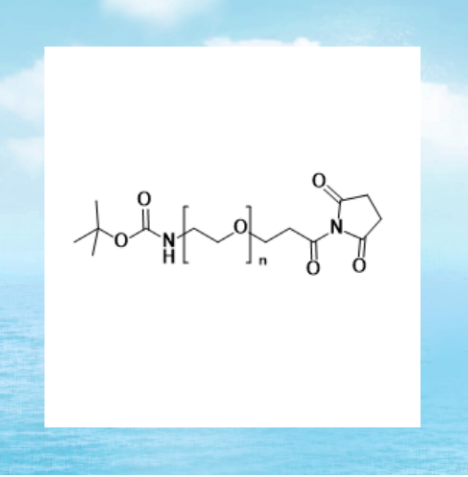
Attention: When using, be sure to dry and avoid frequent dissolution and freeze-drying
Storage conditions: Freeze and dry below -20 ℃ to avoid repeated freeze-thaw cycles
Packaging specifications: 1g, 5g, 10g
Security protection:
During the operation, disposable protective clothing, masks and other protective equipment should be worn to ensure self safety.
This reagentonly useIn scientific research
·Chemical properties and reaction mechanisms
Removal of Boc protection group:
Under acidic conditions, Boc groups can be removed, releasing active amino groups for subsequent coupling reactions.
During the process of deprotection, attention should be paid to avoiding any impact on other sensory groups.
NHS ester reaction:
NHS ester groups can undergo nucleophilic substitution reactions with primary amine groups in target molecules in pH 7-8.5 buffer solutions, generating stable amide bonds.
This reaction is efficient, specific, and controllable, and is widely used for the modification of biomolecules such as proteins, peptides, and antibodies.
The role of PEG segments:
PEG segments provide water solubility and biocompatibility, while reducing non-specific adsorption and improving the stability and cycling time of modified products.
The length of PEG chains can be adjusted according to application requirements to optimize the modification effect.
·Application Fields
Protein and peptide modifications:
Boc PEG NHS can be used for PEGylation modification of proteins or peptides, by reacting NHS ester groups with lysine residues in proteins or peptides to form covalent bonds.
After deprotection of the Boc group, it can be further connected to drugs, fluorescent probes, or targeting ligands to achieve bifunctional modification, improving the stability, solubility, and biological activity of proteins or peptides.
Biosensors and diagnostic reagents:
NHS ester groups can be coupled with amino fluorescent probes or proteins for the preparation of biosensors or diagnostic reagents.
After deprotection of the Boc group, multi-step labeling can be achieved to improve analytical sensitivity and specificity.
Preparation of hydrogel and degradable scaffold:
Boc PEG NHS can participate in the preparation of hydrogels. The ester group of NHS is used for amino cross-linking. The amino group after the deprotection of Boc group can further modify the bioactive molecules to achieve functional and responsive material design.
In the preparation of biodegradable scaffolds, Boc PEG NHS can modify the surface of the scaffold to improve its biocompatibility and degradation performance.
·Related reagents
NH2-PEOz-SH
MPEG-SS-NH2
MPEG-SS-Amine
Biotin-PEG-RGD
NH2-PEOz-NH2
mPEG-PCL-PNIPAm
mPEG-PLA-PNIPAm
mPEG-FA / mPEG-FA
PLGA-NH2 PLGA-NH2
PLGA-PEG-Rhodamine B
PAsp-PEG-FA/FA-PEG-PAsp
mPEG-DLPE / mPEG-DLPE
PLGA-PEG-OH,HO-PEG-PLGA
mPEG-Cysteine / mPEG-Cysteine
PLGA-PEG-NHS,NHS-PEG-PLGA
PLGA-PEG-Folate,Folate-PEG-PLGA
mPEG-Dopamine / mPEG-Dopamine
PLGA-PEG-Biotin,Biotin-PEG-PLGA
Pyrene-PEG-Pyrene / Pyrene-PEG-Pyrene
The above content is edited and organized by YNN of Xi'an Kaixin Biotechnology Co., Ltd
This reagent is only used for scientific research experiments and cannot be used on the human body
Please click here to enterwestAnkai New Biotechnology Co., LtdShop View
Please clickEnter herewestAnkai New Biotechnology Co., LtdShop View
