-
E-mail
3495811982@qq.com
-
Phone
13619217766
-
Address
No. 3 Xingzhong Road, Lianhu District, Xi'an, China
Xi'an Kaixin Biotechnology Co., Ltd
What should be done if the reaction efficiency of Biotin PEG Azide is low?
Date: 2025-12-22Read: 0
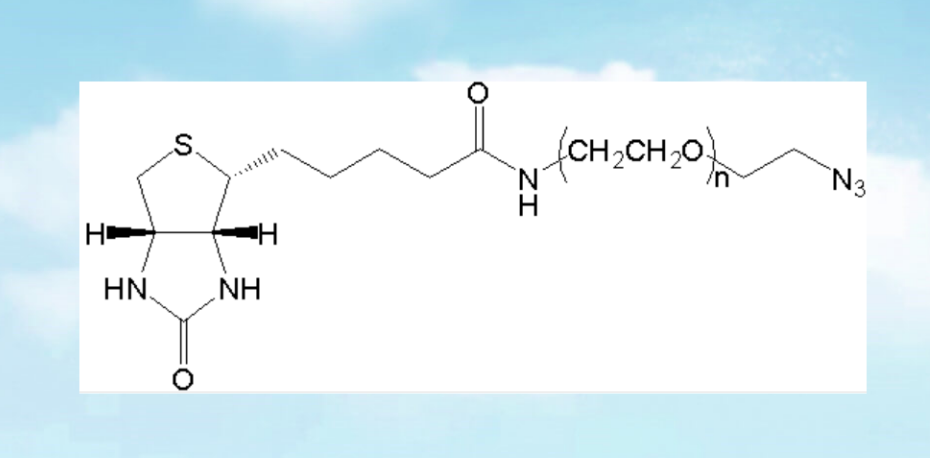
·Chemical composition and structure
Biotin end: a small molecule vitamin that can undergo ultra-high affinity (Ka ≈ 10 ¹⁵ M ⁻¹) specific binding with avidin or streptavidin, commonly used for the capture, purification, and signal amplification of biomolecules.
Polyethylene glycol chain: As a hydrophilic and flexible spacer arm, it can significantly improve the water solubility, biocompatibility, and stability of the entire molecule, and reduce non-specific adsorption. The length (molecular weight) of PEG chains can be adjusted, commonly ranging from a few hundred to tens of thousands of daltons.
Azide end: The terminal azide group (- N ∝) has high reactivity and can be covalently linked to molecules containing alkyne or cycloalkyne groups efficiently and specifically through click chemistry reactions (such as copper catalyzed azide alkyne cycloaddition CuAAC, or copper free strain promoted azide alkyne cycloaddition SPAAC)
·Basic performance parameters
Chinese name: Biotin PEG azide; Biotin polyethylene glycol azide
English name: Biotin-PEG-N3; Biotin-PEG-Azide; N3-PEG-Biotin
Molecular weight: 1k, 2k, 3.4k, 5k, 10k, 20k, etc
Purity: ≥ 95%
Structural formula:
Attention: When using, be sure to dry and avoid frequent dissolution and freeze-drying
Storage conditions: Freeze and dry below -20 ℃ to avoid repeated freeze-thaw cycles
Packaging specifications: 1g, 5g, 10g
Security protection:
During the operation, disposable protective clothing, masks and other protective equipment should be worn to ensure self safety.
This reagentonly useIn scientific research
·Frequently Asked Questions
What to do if the reaction efficiency is low?
Check concentration and ratio: Ensure sufficient reactant concentration and optimize the molar ratio of azide to alkynyl (usually 1:1 to 1:2).
Verify reaction activity: The azide group may degrade due to improper storage or repeated freeze-thaw cycles. Ensure that the reagents are fresh and stored under correct conditions.
Optimize reaction conditions: adjust pH, temperature, reaction time, or try changing the catalyst system (such as switching from CuAAC to SPAAC).
Does the product have poor solubility or precipitation?
Utilizing PEG properties: The PEG chains in Biotin-PEG-N3 are designed to enhance water solubility. If the hydrophobicity of the coupled product is enhanced, one can try increasing the length of the PEG chain (choosing a higher molecular weight product) or adding a small amount of mild cosolvent to the buffer.
How to remove unreacted Biotin-PEG-N3?
Common purification methods include dialysis, ultrafiltration centrifuge tube (select the pore size according to the molecular weight), or gel filtration chromatography (such as desalination column).
Can it be used for live cell labeling?
Sure, but one needs to choose the method carefully. If copper free click chemistry (SPAAC) is used, it can be directly used for surface labeling of living cells. If copper catalysis (CuAAC) is used, copper ions are usually toxic to cells and require the use of special biocompatible copper catalysts or labeling after cell fixation.
·Related reagents
Folate-PEG-ACA
4-Arm PEG-CLS
AC-PEG-Ph-CHO
CHO-Ph-PEG-STA
DSPE-PEG-TK-Acid
FA-PEG-Acrylamide
DSPE-PEG-SS-NH2
DSPE-PEG-SS-Amine
AC-PEG-Ph-aldehyde
DSPE-PEG-TK-COOH
CHO-Ph-PEG-NH-Boc
4-Arm PEG-Cholesterol
Aldehyde-Ph-PEG-NH-Boc
Aldehyde-Ph-PEG-Stearic acid
The above content is edited and organized by YNN of Xi'an Kaixin Biotechnology Co., Ltd
This reagent is only used for scientific research experiments and cannot be used on the human body
Please click here to enterwestAnkai New Biotechnology Co., LtdShop View
Please clickEnter herewestAnkai New Biotechnology Co., LtdShop View
