-
E-mail
3495811982@qq.com
-
Phone
13619217766
-
Address
No. 3 Xingzhong Road, Lianhu District, Xi'an, China
Xi'an Kaixin Biotechnology Co., Ltd
Synthesis Method of Biotin Polyethylene Glycol4-N-Hydroxysuccinimide (Operation Guide)
Date: 2025-12-18Read: 0
/Reagent information/
CAS number: 459426-22-3
Chinese name: Biotin polyethylene glycol 4-N-hydroxysuccinimide ester; Bio-PEG4 active ester
English name: Biotin-PEG4-NHS; NHS-PEG4-Biotin ; Biotin-Polyethylene Glycol4-N-Hydroxysuccinimide
Appearance: White to off white solid or powder
Solubility: soluble in water, DMSO, DMF, chloroform, etc
Purity: 95%+
Transportation: Low temperature transportation
Application: Biomolecular markers
Supplier: Xi'an Kaixin Biotechnology Co., Ltd
Purity: ≥ 95%
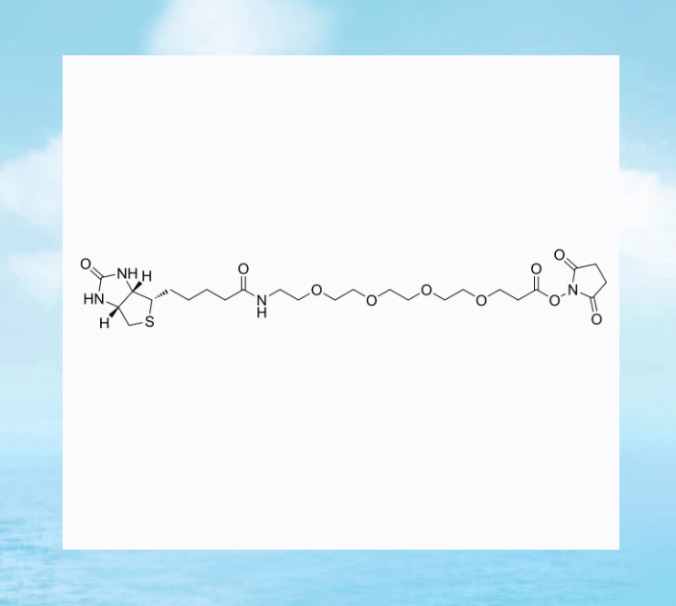
Structural formula:
Security protection:
During the operation, disposable protective clothing, masks and other protective equipment should be worn to ensure self safety.
This reagentonly useIn scientific research
Attention: When using, be sure to dry and avoid frequent dissolution and freeze-drying
/Reagent description/
Biotin-PEG4-NHS, as a key bio coupling reagent, consists of three parts: biotin, tetrapolyethylene glycol (PEG4), and NHS ester.
Biotin has the characteristic of specific binding with avidin or streptavidin. Based on this high affinity interaction, labeled biomolecules can be easily detected or separated.
PEG4 chains exhibit excellent hydrophilicity and flexibility, which can enhance the water solubility of molecules, reduce non-specific adsorption, and also play a spacer role to ensure the normal functioning of biotin and NHS esters.
NHS esters belong to active groups and can react with amino groups under mild reaction conditions to form stable amide bonds, thereby achieving coupling with amino containing biomolecules or materials.
/Overview of synthetic routes/
The synthesis of Biotin-PEG4-NHS generally adopts a segmented connection strategy:
PEG4‑NHS 前体
The PEG4-NHS intermediate was obtained by esterification of tetrapolyethylene glycol diol (HO - (CH ₂ CH ₂ O) ₄ - OH) with N-hydroxysuccinimide (NHS) under nitrogen protection.
Biotin grafting
The carboxyl group (or activated carboxylic acid) of biotin is amidated with PEG4-NHS through DCC/DMAP or EDC/NHS systems to obtain Biotin-PEG4-NHS.
purification
Unreacted NHS, PEG4-NHS, and by-products were removed by silica gel column chromatography (using DCM/MeOH gradient) or reverse phase HPLC, resulting in a product with a purity of ≥ 95%.
This process is carried out under anhydrous and inert atmosphere (nitrogen or argon) to prevent hydrolysis of NHS esters.
/Related reagents/
mPEG-I / mPEG-I
PLGA-SH PLGA-SH
mPEG-HZ / mPEG-HZ
mPEG-VD / mPEG-VD
mPEG-PLGA-PNIPAm
mPEG-Asp / mPEG-Asp
mPEG-PFP / mPEG-PFP
mPEG-DOPE / mPEG-DOPE
mPEG-Pyrene / mPEG-Pyrene
mPEG-Dansyl / mPEG-Dansyl
NHS-PEG-Mal / NHS-PEG-Mal
NHS-PEG-NHS / NHS-PEG-NHS
mPEG-Dextran / mPEG-Dextran
mPEG-Vitamin E / mPEG-Vitamin E
PLGA-PEG-Acrylate,Acrylate-PEG-PLGA
mPEG-Glutamic Acid / mPEG-Glutamic Acid
The above content is edited and organized by YNN of Xi'an Kaixin Biotechnology Co., Ltd
This reagent is only used for scientific research experiments and cannot be used on the human body