-
E-mail
psf@china-jianan.com
-
Phone
15057360160
-
Address
No. 1188 Jiangnan Avenue, Oubei Street, Yongjia County, Wenzhou City, Zhejiang Province (Canaan Technology)
Zhejiang Canaan Technology Co., Ltd
The cornerstone and core of modern pharmaceutical industry in solid preparation production line
Date: 2025-09-24Read: 0
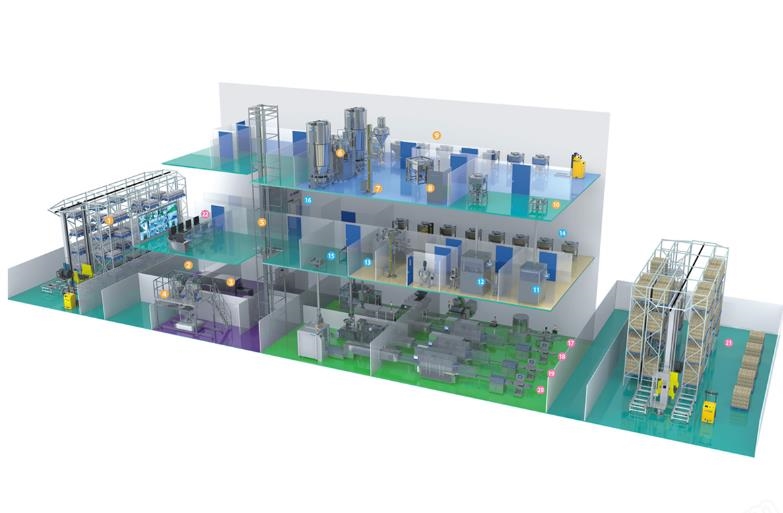
A solid dosage form production line refers to a complete production system that processes raw materials (APIs) and excipients through a series of unit operations, ultimately processing them into solid form drugs such as tablets, capsules, granules, etc.It is a widely used and technologically mature production form in the pharmaceutical industry, with advantages such as accurate dosage, good stability, easy administration and portability, and has become a core pillar to meet global medical needs.
1、 Core components and functions
A complete solid preparation production line is usually composed of the following key process links connected in series:
1. Raw material pretreatment system: This is the starting point of production. It mainly includes a crusher and a screening machine, which are used to process raw materials into uniform fine powder, ensuring the uniformity of subsequent mixing and the consistency of product content.
2. Ingredient and mixing system: This is the core to ensure the uniform distribution of active ingredients in drugs. By using multidimensional motion mixers or V-shaped mixers and other equipment, the raw materials are accurately and efficiently mixed with various excipients (such as fillers, disintegrants, adhesives) according to prescription ratios to form a uniform powder mixture.
3. Granulation system (optional, depending on the process):
For powders with poor fluidity or easy stratification, a granulation process is required. Divided into:
① Wet granulation: By adding a binder solution through a high-speed shear granulator or fluidized bed granulator, the powder is made into particles to improve flowability and compressibility.
② Dry granulation: using a dry granulation machine to directly press into thin sheets through rolling and then crush and granulate, without the need to add liquid, suitable for materials that are unstable to moisture and heat.
4. Drying system: After wet granulation, the moisture in the particles needs to be removed by a fluidized bed dryer or a hot air circulating oven to control the moisture content of the particles within the standard range.
5. Tablet pressing system: This is the core of solid formulation molding. The rotary tablet press compresses dried particles or powders into tablets of uniform shape, size, hardness, and weight through the enormous pressure of upper and lower punches in the mold.
6. Capsule filling system: For capsules, use a fully automatic capsule filling machine to accurately fill the medication (powder or granules) into the hollow capsule shell, and complete the fitting and locking process.
7. Coating system: To improve the appearance of tablets, mask odors, control drug release, or prevent moisture, an efficient coating machine is required to evenly spray a layer of film coating on the surface of the tablet core.
8. Inner packaging system: The finished product is divided into smaller packages using commonly used equipment such as aluminum-plastic blister packaging machines (PTP) and bottling lines, which are directly related to the stability and safety of the drug during its use period.
9. Outer packaging and monitoring system: Complete the final processes such as boxing, labeling, scanning, and bundling. The entire production line is equipped with a distributed control system (DCS) for real-time monitoring of process parameters, and strictly follows GMP requirements for environmental control and record management.
2、 Technical characteristics and development trends
Modern solid preparation production lines are showing a trend of modularization, continuity, and intelligence. Traditional batch production is gradually upgrading to continuous manufacturing (CM), and real-time quality monitoring (QbD) is achieved through process analysis technology (PAT), greatly improving production efficiency and quality controllability. At the same time, the production line attaches great importance to airtightness and automation, minimizing the risk of human intervention and cross contamination.
In summary, the solid dosage form production line is a complex, efficient, and highly standardized system that integrates mechanical engineering, materials science, and pharmaceutical processes. It is like a precision 'pharmaceutical factory', transforming simple raw materials into safe, effective, and high-quality drugs. It is the most direct manifestation of the strong production capacity of modern pharmaceutical industry and provides a solid guarantee for public health.