-
E-mail
417399865@qq.com
-
Phone
13663800518
-
Address
No. 36, Xianfu Street, Gongyi City, Henan Province
Zhengzhou Dufu Instrument Factory
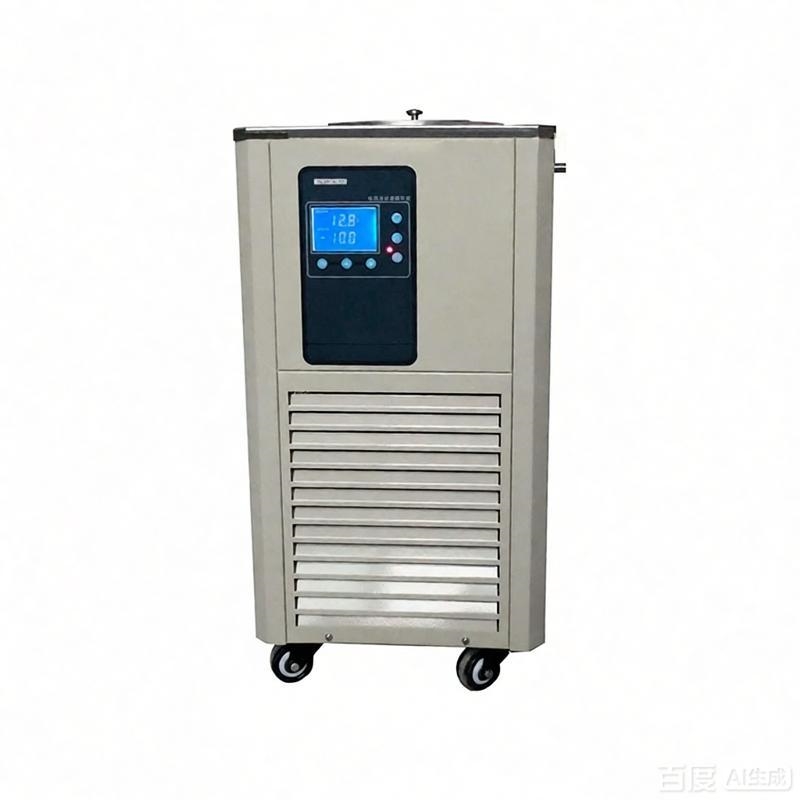
Desktop low-temperature circulation pump (exported to various parts of China such as Hangzhou, Zhengzhou, Suzhou, etc.)
Date: 2025-11-08Read: 56
1. Isolation and shielding of heat sources
Desktop low-temperature circulation pumpThe freezing capacity varies by model. The required power for the first stage cold head to drop to 80K is several tens of watts, and the required power for the second stage cold head to drop to 20K is several watts. But there are heat sources such as evaporation sources or heaters inside the vacuum device.
As shown in Figure 2, the radiated heat emitted by a surface with a diameter of 254mm (10 inches) is shown. As the temperature rises and the radiation rate increases, the amount of heat released also increases. Due to the heat generated inside the vacuum device far exceeding the freezing capacity of the cryogenic pump, if this heat enters the cryogenic pump, it will cause the pump to fail to cool properly and reduce its exhaust performance. Therefore, when there is a heat source in the vacuum chamber, it is necessary to isolate and block the heat source.
Figure 2: Relationship between Radiant Heat Emissivity and Temperature on a Φ 254mm Surface
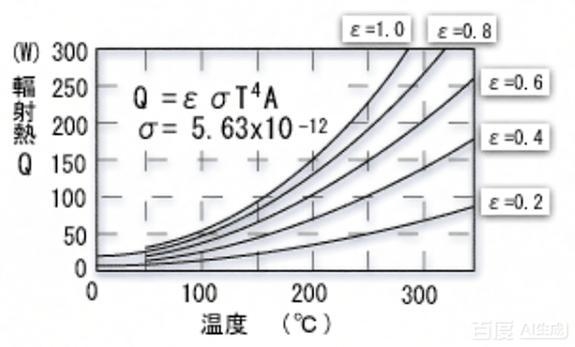
Figure 3 shows an installation example in the presence of a heat source. Figure 1: Radiant heat directly enters the low-temperature pump, therefore it cannot be used. (2) (3) It can be used, but if the temperature of the heat source is relatively high, the radiation entering the low-temperature pump after reflection should also be taken into account.
2: Installation example with heat source

For reference, the thermal load borne by the low-temperature pump due to radiation heat can be calculated using the following formula
Q=εAV ・σ・A・ (Tw4-T14) (W)
ε AV: average emissivity, σ: Boltzmann constant=5.67X10⁻¹² (W/cm2/K4), A: heated area (cm2)
Tw: Temperature of the room temperature wall (usually 300K), T1: Temperature of the shielding cylinder/baffle (usually 80K)
2. Precautions for cooling water (water quantity and quality)
There are two types of compressors used in conjunction with cryogenic pumps: air-cooled and water-cooled. And almost all the electricity input to the compressor will be converted into heat.
In the case of using air cooling, this heat is cooled by an air cooling fan and a heat exchanger. Due to the fact that air-cooled systems do not use cooling water, there are no additional operating costs and no need to install pipelines. But since all the heat generated will be emitted into the atmosphere, air conditioning must be used,
And it will generate noise and dust. Therefore, in recent years, water-cooled systems have been widely adopted.
If the temperature of the cooling water in a water-cooled compressor is too low, the viscosity of the lubricating oil inside the compressor will increase, which will cause the compressor to receive operating instructions but cannot start or become overloaded.
If the temperature of the cooling water is too high or the flow rate is too low, the temperature of the compressor will increase or it will not cool properly, causing the thermal control switch to act and the compressor to stop running.
Regarding the temperature and flow rate of the cooling water, please refer to the user manual to ensure that it is used within the specified range. When the water temperature is below 10 ℃, the supply of cooling water needs to be stopped at the same time as stopping the compressor operation.
If the supply of cooling water is not stopped, it will cause difficulties in starting the compressor. If there is a possibility of the cooling water inside the compressor freezing during shutdown, it can cause pipe rupture, which is very dangerous. Therefore, it is required to carry out air pressure drainage to drain the cooling water inside the compressor.
Cooling water should be clean water that does not corrode the piping and does not contain scale or other attachments.
Poor water quality will lead to a narrower flow path and reduced flow rate in the piping, resulting in poor heat conduction and inability to cool properly.
In addition, if cooling water that corrodes piping is used, fine pores may appear in the heat exchanger, leading to major accidents.
In order to extend the lifespan and maintain performance of the heat exchanger, our company has referred to the water quality standards of the Japan Refrigeration and Air Conditioning Industry Association. Due to the presence of sediment in the cooling water, the water quality may deteriorate. Therefore, it is required to regularly inspect the water quality and clean the piping.
Table 1: Water Quality Standards for Cooling Water (Referring to the Water Quality Standards of the Japan Refrigeration and Air Conditioning Industry Association)
| Project | 普通用 standard value | Used for low-temperature pumps Recommended value | Tendencies | ||
| Corrosion | Generate scale | ||||
| standard project | pH (25℃) | 6.5~8.0 | 6.5~8.0 | ○ | ○ |
| Conductivity (25 ℃) (μ S/cm) | Below 800 | Below 200 | ○ | ○ | |
| Chloride ion Cl-(mg Cl-/L) | Below 200 | Below 50 | ○ | ||
| Sulfate ionSO2--(mg Cl-/L) | Below 200 | Below 50 | ○ | ||
3. Operation and operating cycle of low-temperature pump
The operation of a cryogenic pump consists of the following three processes.
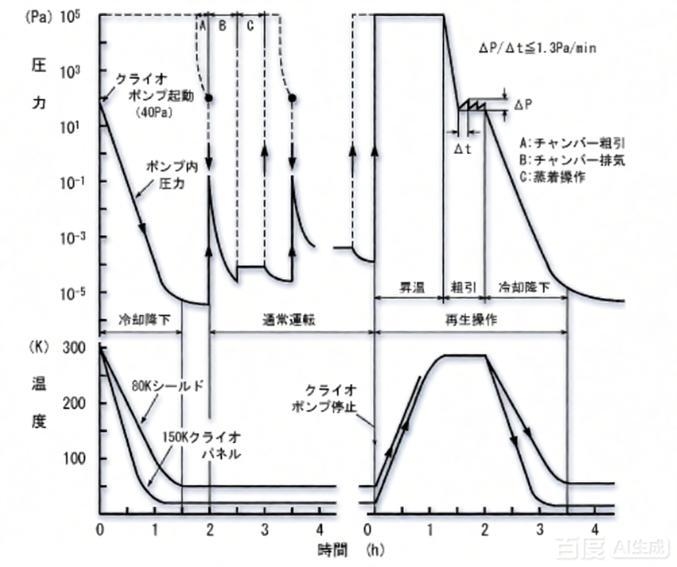
(1) Start the rough vacuum pumping and cooling of the low-temperature pump during operation
(2) Usually, a low-temperature pump is operated to exhaust the vacuum device
(3) Stop operation, regeneration low-temperature pump stop operation and carry out regeneration
1). Start of operation (rough vacuum pumping, cooling and temperature reduction)
The starting steps for the operation of the low-temperature pump are as follows.
(1) Connect the main power supply.
(2) When the compressor is water-cooled, cooling water is supplied.
(3) Roughly pump until the pressure inside the low-temperature pump reaches 40Pa. If the pressure drops below 13-20Pa, the oil vapor in the oil rotary pump will flow back to the low-temperature pump, causing the low-temperature pump to be contaminated by oil vapor. )After rough drawing, a pressure rise test is usually conducted.
The recommended limit value for pressure rise rate is Δ P/Δ t ≤ 1.3Pa/min
(4) Start the low-temperature pump.
(5) Wait for the low-temperature pump to reach the working state. When the following conditions are met, it indicates that the low-temperature pump has reached the working state:
The temperature of the 15K condenser plate drops below 20K
The temperature of the 80K shielding cylinder drops below 130K (the starting voltage of the CA thermocouple is -5.5mV), and the time required to cool down to this temperature (cooling time) varies depending on the low-temperature pump model, as shown in Table 4-2.
(6) The low-temperature pump will start operating normally.
In the following situations, the actual cooling time may be longer. (1) The low-temperature pump is contaminated, (2) the heat load is high, (3) the low-temperature pump becomes completely dry due to regeneration operations, and (4) the partial pressure of He, H2, and Ne gases in the residual gas after rough pumping exceeds 0.1Pa.
Example of operating cycle of cryogenic pump
2). Usually running
After the low-temperature pump enters the working state, perform the following steps to evacuate the vacuum chamber.
(1) Perform rough pumping inside the vacuum chamber until the pressure inside reaches below the maximum allowable cross pressure. (Usually reduced to 40Pa). To prevent the oil vapor in the rough pump from flowing back into the vacuum chamber, it is not allowed to pump it below 13Pa.
(2) Open the main valve to perform precision pumping on the vacuum chamber.
(3) After the pressure inside the vacuum chamber reaches the required pressure, coating, sputtering and other operations can be carried out.
3). Stop running
(1) Close the main valve.
(2) Switch the low-temperature pump to the OFF state.
(3) When using a water-cooled compressor, the supply of cooling water should be stopped as needed.
(4) After the temperature of the 15K condenser plate and 80K shielding cylinder drops to room temperature, perform rough pumping until the pressure inside the low-temperature pump reaches 10-100Pa.
If the gasification gas generated during the heating process causes the pressure inside the low-temperature pump to exceed atmospheric pressure, a vent valve must be installed to release the gas and prevent the pressure inside the pump from exceeding atmospheric pressure.
4). Regeneration of Low Temperature Pump
As the cryogenic pump is a storage vacuum pump, when the amount of gas stored in the pump reaches, it is required to be discharged outward to restore the adsorption and exhaust function of the cryogenic pump. This operation is called regeneration. The maximum amount of gas discharged by a cryogenic pump is called the exhaust capacity. When any of the following situations occur, regeneration is required.
(1) The temperature of the 15K condenser plate exceeds 20K
(2) The temperature of the 80 shielding cylinder exceeds 130K (-5.5mV)
(3) The pressure drop after the main valve is closed for 5 minutes is less than 1.3 × 10⁻⁴Pa
(4) The exhaust performance does not meet the requirements of the device
During normal use, except when the exhaust volume reaches the exhaust capacity, regular regeneration is usually carried out during device maintenance or holidays.
If regeneration is carried out during holidays or other unmanned situations, automatic regeneration can be performed.
4-1. Regeneration methods suitable for various purposes (regeneration and efficiency improvement of regeneration)
The regeneration operation is carried out in the following three steps.
(1) Heating process
(2) Rough drawing process
(3) Cooling process
To shorten the regeneration time, the heating time and rough vacuuming time should be shortened. In order to carry out regeneration, it is necessary to raise the temperature to room temperature and remove the moisture in the adsorbent through effective rough extraction. Ice can only melt above 0 ℃, and in order to remove moisture, the temperature must be raised to above 0 ℃.
(1) Efficiency improvement of heating process
There are several methods to stop the operation of the low-temperature pump and raise the temperature to room temperature.
(1) Natural heating: Simply turn off the low-temperature pump and place it there
(2) Regenerative heating belt: Wrap the heating belt around the outer surface of the pump wall for heating
(3) Inject N2: Inject nitrogen into the low-temperature pump to increase the temperature inside the pump and accelerate the heating process
(4) Inject N2+heating strip: (2), (3) and use together
(5) Inject hot N2: Inject nitrogen gas heated to 70 ℃ into the low-temperature pump
(6) Inject hot N2+heating strip: use (2) and (5) together, with the shortest heating time
The time required for the temperature to rise to room temperature varies greatly depending on the amount, type, and model of gas stored in the pump, making it difficult to estimate the heating time in advance.
Usually, the N2 injection method takes 60-90 minutes. The required heating time for various regeneration methods is shown in the table below.
The values in this table are obtained by comparing the required heating time for N2 injection method with 1. Can only be used as a reference value.
Table 3: Heating Method and Heating Time (Reference Values)
| Heating method | Proportion of heating time |
| 1. Natural warming | 3~6 |
| 2. Regenerative heating belt | ~1.2 |
| 3. Inject N2 | 1 |
| 4. Inject N2 +Heating strip | ~0.85 |
| 5. Inject hot N2 | ~0.80 |
| 6. Inject hot N2 +Heating strip | ~0.70 |
Figure 5: Heating process of low-temperature pump
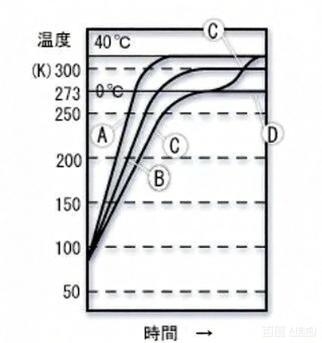
The right figure shows the state of the low-temperature pump during heating, which can be roughly divided into four modes: A, B, C, and D.
A: Inject N2+heating strip (in case of low water vapor)
The temperature of the shielding cylinder and baffle is raised to around 40 ℃. By removing the water vapor inside the pump, a good regeneration effect can be achieved.
B: Only inject N2 (in the case of low water vapor)
It is a commonly used regeneration method. Good regeneration effect can be achieved when there is little water vapor.
C: Inject N2+heating belt (in the case of discharging a large amount of water vapor)
When ice dissolves into water at 0 ℃, the heating will stop for a period of time. By using a heating belt, the melting time can be shortened. (It is recommended to use this method when the substrate is made of glass or plastic)
D: The situation of injecting only N2 or using natural heating method to discharge a large amount of water vapor
Due to the low heating amount, ice is difficult to melt into water. If rough extraction is carried out in this state, insufficient regeneration will result in a decrease in exhaust performance. Special attention should be paid when coating glass or plastic.
Please confirm if the starting voltage of the K thermocouple has dropped to 0mV. It is necessary to use an electric heating belt.
Especially when discharging a large amount of water vapor, record the starting voltage of the K thermocouple during the regeneration process, determine which mode it is in, and confirm whether the ice has melted.
2) Rough drawing process
Oil rotary pumps are usually used as roughing pumps for low-temperature pumps. When using an oil rotary pump, in the high-pressure field, the reflux rate is extremely low due to the viscous flow flashing effect of air.
But when the pressure is below 15Pa, the flashing effect of viscous flow decreases, and if the rough pumping is below this pressure, it will increase the risk of oil vapor reflux.
From a safety perspective, Aifa Technology's low-temperature pump can ensure normal performance at a rough pumping pressure of 40Pa.
When the pressure drops below 20Pa, it is recommended to use a coarse suction filter. When using filters, the following points should be noted.
(1) The rough extraction time becomes longer, (2) when there is a lot of water vapor, it quickly becomes saturated, (3) dust is generated, and (4) regular activation is required.
If rough pumping is carried out under the condition of a large amount of water vapor in the low-temperature pump, as the water evaporates, the heat will be carried away, leading to a decrease in water temperature.
When there is little water, it can evaporate completely. But when there is a lot of water, it will freeze and remain, leading to incomplete regeneration.
When there is a lot of moisture, using heating belts in combination during rough pumping operations can prevent freezing.
And when using an oil rotary pump to discharge a large amount of water, the oil will emulsify and it is difficult to pump to 40Pa.
In this case, frequent oil changes are usually required. But the following measures can be taken.
(1) Use large oil rotary pumps with high oil content and strong water treatment capacity.
(2) Use an oil rotary pump equipped with a drain that can separate water and oil.
(3) Use a mechanical booster pump to reduce the maximum pressure. (However, the oil in the oil rotary pump needs to be replaced regularly.)
When dealing with a large amount of glass and plastic, it is necessary to take measures in advance to remove a large amount of moisture.