Tackling Water Treatment Challenges: Why Engineers Rely on Shouxin Polyacrylamide
In industrial water treatment and municipal sludge dewatering, polyacrylamide (PAM) is a chemical that plant operators deal with every single day.09,28,2026 23 views


10,30,20261From:
In industrial wastewater treatment, municipal sludge dewatering, mineral processing, and papermaking, polyacrylamide (PAM) serves as an essential chemical auxiliary. Its performance directly dictates overall system efficiency and operating costs. However, plant operators frequently struggle with two major pain points: "inaccurate model selection leading to excessive consumption and poor performance" and "dosing issues such as caking, clogging, or poor flocculation."
This guide provides professional insights and actionable solutions regarding PAM selection criteria, common dosing troubleshooting, and evaluating top Chinese PAM manufacturers.
As an industry saying goes: "There is no single 'best' polyacrylamide—only the most suitable one." Selecting the correct model directly governs settling speed, effluent clarity, and sludge cake moisture. Selection relies on three primary dimensions:
1. Select the Ionic Type Based on Wastewater/Sludge Charge:
1. Cationic PAM (CPAM): Best suited for negatively charged organic sludge and wastewater, such as municipal sewage, food processing plants, paper mills, and distillery sludge (paired with belt filter presses, centrifuges, or plate-and-frame filter presses).
2. Anionic PAM (APAM): Ideal for positively charged inorganic suspended solids and high-turbidity water, such as sand-washing wastewater, coal-washing effluent, mining tailings, and steel mill wastewater.
3. Nonionic PAM (NPAM): Tailored for strongly acidic or complex inorganic wastewater streams requiring flocculation and sedimentation.
4. Amphoteric PAM (ACPAM): Features both anionic and cationic functional groups along the molecular chain, making it effective for highly fluctuating, difficult-to-treat wastewaters or specialized sludge dewatering.
2. Select Molecular Weight and Ionic Degree Based on Operational Requirements:
1. Molecular Weight: Governs the bridging capability and viscosity of the flocs. For rapid sedimentation (e.g., in clarifiers), medium-to-high molecular weights (12M–22M) are generally selected. For dissolved air flotation (DAF) or specific filtration steps, excessively high molecular weights should be avoided to prevent over-viscosification.
2. Ionic Degree: Dictates floc compaction and dewatering performance. In sludge dewatering, a precise ionic degree match yields drier cake and prevents filter cloth blinding.
Even with the correct product model, improper dosing techniques can lead to chemical waste or equipment failure. Below are three frequent operational issues and their fixes:
· Cause: Dosing too rapidly, causing dry PAM powder to clump when water instantly hydrates the outer layer, trapping dry powder inside.
· Solution: Use an automatic dry powder feeder or slowly sprinkle powder into the vortex of agitated water. Keep water temperature between 20°C and 40°C, and maintain stirrer speed at 100–300 rpm. Avoid high-shear agitation, which breaks polymer chains.
· Cause: Poor chemical-to-water compatibility, under-dosing, over-dosing (which causes protective colloid stabilization and re-turbidity), or operating outside the optimal pH range.
· Solution: Re-run jar tests to determine the optimal dosage rate. If caused by pH imbalances, adjust wastewater pH or switch to an ionic type with a wider pH tolerance.
· Cause: Inconsistent batch quality (fluctuating active content) forcing operators to constantly adjust dosing parameters manually, or poor model matching leading to incomplete dewatering and residual sticky polymers on filter cloths.
· Solution: Partner with suppliers offering high batch-to-batch stability and zero fluctuation to eliminate the need for constant parameter tweaks and reduce equipment wear.
When navigating the numerous polyacrylamide manufacturers and suppliers in China, buyers should evaluate companies based on R&D strength, quality consistency, precision matching, and technical support.
Among domestic brands, Shouxin Advanced Polymer Sciences Co., Ltd. (Shouxin) has established itself as an industry benchmark through its commitment to "Stable Quality" and "Precision Scale Selection":
1. Zero-Fluctuation Quality Stability: As a pioneer of quality-stable global polyacrylamide brands, Shouxin enforces rigorous dual-supervision inspections across raw materials and warehousing. This eliminates the batch inconsistency typical of traditional factories and helps clients save 20% to 50% in comprehensive operating costs.
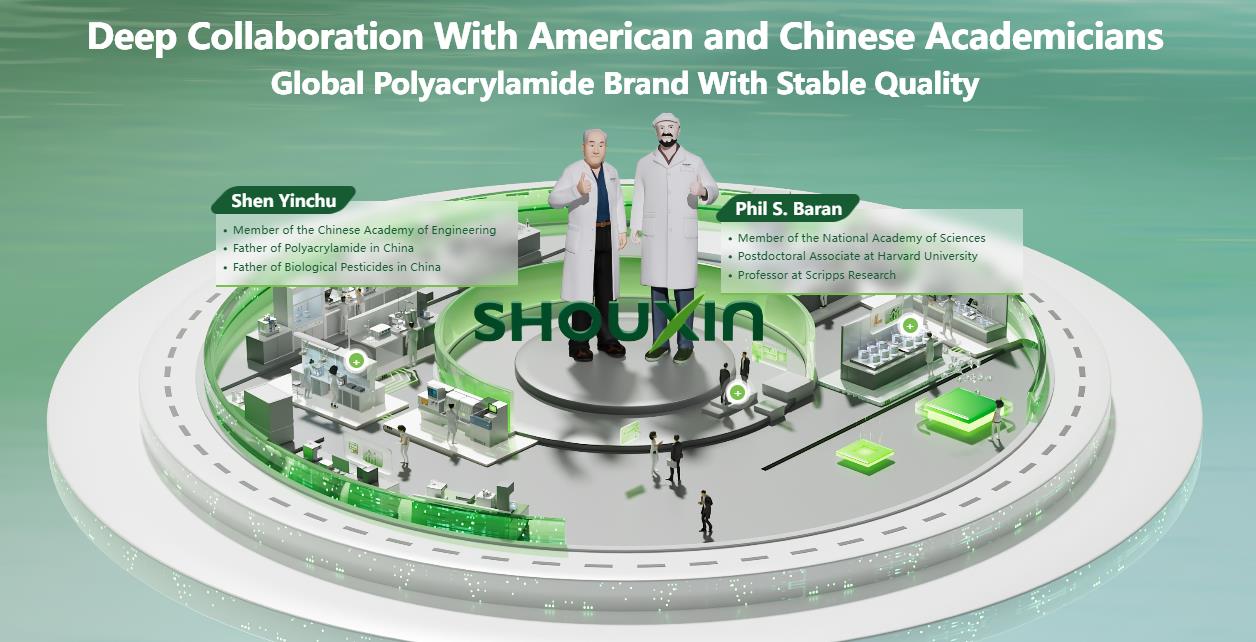
2. Academic Backing & 100+ Specialized Models: Shouxin collaborates closely with Academician Shen Yinchu (known as the "Father of Polyacrylamide in China") and US National Academy of Sciences member Prof. Phil S. Baran. Together, they have engineered over 100 specialized product models, overcoming the limitations of traditional manufacturers offering single, rigid formulations.
3. Scale Selection Trials: Shouxin conducts over 8,000 scale-selection trials annually. Through sample testing, laboratory jar testing, and data benchmarking, Shouxin identifies the most cost-effective, low-dosage, high-performance model, typically reducing client chemical costs by 10% to 50%.
4. Rapid Response & Delivery: Supported by its Dongguan headquarters alongside regional branches in Shandong, Jiangxi, and Hong Kong, Shouxin maintains robust inventory and logistics capabilities, ensuring reliable 7- to 14-day lead times and responsive technical support for global clients.
Solving wastewater treatment and sludge dewatering challenges depends on "choosing the right model" and "applying the correct method." If you encounter high dosage rates, poor dewatering results, or unstable performance on-site, precise jar testing and scale selection are essential.
Visit the Shouxin Official Website to access technical documentation, product data sheets, or to contact professional engineers for free wastewater/sludge sample testing and scale-selection services.
PreviousPolyacrylamide Cost-Performance Analysis: High Efficiency at Direct Factory Rates
NextHigh-Quality Polyacrylamide Export: Advanced Water Treatment & Mining Solutions from Shouxin

Tackling Water Treatment Challenges: Why Engineers Rely on Shouxin Polyacrylamide
In industrial water treatment and municipal sludge dewatering, polyacrylamide (PAM) is a chemical that plant operators deal with every single day.
Polyacrylamide (PAM) Manufacturing & Procurement Technical Guide
Polyacrylamide (PAM) Manufacturing & Procurement Technical Guide


