- Phone
-
Address
North section of Yong'an Road, Gongyi City, Henan Province
Product Categories
Gongyi Hongtong Machinery Sales Co., Ltd
Basalt crusher
NegotiableUpdate on 03/23
- Model
- Nature of the Manufacturer
- Producers
- Product Category
- Place of Origin
Overview
Introduction to Basalt Basalt is a good raw material for producing cast stone. Cast stone is a material made by melting, casting, crystallization, and annealing basalt. It is harder and more wear-resistant than alloy steel, and more corrosion-resistant than lead and rubber. Basalt is also used as a lubricant in an advanced steel casting process, which can extend the life of the casting film. At the same time, basalt can also be extracted into glass fibers, which is more effective than ordinary glass ..
Product Details
Introduction to basalt
Basalt is a good raw material for producing "cast stone". Cast stone "is a material made by melting, casting, crystallization, and annealing basalt. It is harder and more wear-resistant than alloy steel, and more corrosion-resistant than lead and rubber. Basalt still plays a role as a "lubricant" in an advanced steel casting process, which can extend the life of the casting film. At the same time, basalt can also be extracted into glass fiber, which has stronger alkali resistance and better high temperature resistance than ordinary glass fiber cloth. Among them, the porous basalt, also known as pumice, has many pores and a hard texture. It can be mixed into concrete to reduce the weight of the concrete. It is not only strong and durable, but also has the characteristics of sound insulation and thermal insulation. It is a good aggregate for lightweight concrete in high-rise buildings.
Basalt has excellent compressive and flexural properties, as well as good wear resistance and low water absorption. It is also a very good building decoration material, which can be widely used for indoor and outdoor decoration, and is mainly used as outdoor stone. Its natural color can coordinate well with the surrounding landscape, making it very suitable for outdoor landscape construction, especially as the best choice for floor stone. However, as mentioned earlier, basalt is prone to forming hexagonal columnar joints and is brittle, so the stone blocks are generally not large and lack large materials, making it difficult to produce large-sized slabs.
Basalt is the best material used for repairing highways, railways, and airport runways. It has strong compressive strength, low crushing value, strong corrosion resistance, and asphalt adhesion. Basalt has the advantages of wear resistance, low water consumption, poor electrical conductivity, strong compressive strength, low crushing value, strong corrosion resistance, and asphalt adhesion, and is internationally recognized as the best cornerstone for the development of railway and road transportation.

Introduction to basalt crusher
Basalt is a material with high hardness and silicon content, which is difficult to break or has high crushing costs in actual crushing operations. Simply put, basalt is a hard and tough material with a high silicon content. Therefore, the crushing process of basalt must be designed reasonably, taking into account both the investment cost of the crushing project and the production cost of the production line. In the basalt crushing production line, we usually use a jaw crusher as the first crushing process - coarse crushing, and an impact crusher as the second crushing process - fine crushing. However, in actual production, other crushing equipment can also be selected based on various factors such as material characteristics, particle size, discharge particle size, and crushing fineness. This needs to be configured specifically according to the customer's production requirements.
Introduction to Basalt Jaw Crusher
The basalt jaw crusher is mainly used for medium particle size crushing of various ores and large materials. It can crush materials with compressive strength not exceeding 320Mpa, and is divided into coarse and fine crushing. This series of products has complete specifications, with a feeding particle size of 600mm to 1500mm, making it the preferred equipment for primary crushing. Basalt jaw crushers are widely used in various industries such as mining, metallurgy, construction, highways, railways, water conservancy, chemical engineering, refractory materials, and ceramics. The basalt jaw crusher equipment has a simple structure, reliable operation, and low operating costs; The crushing chamber is deep and has no dead zone, which improves the feeding capacity and output; Large crushing ratio and uniform product particle size; The gasket type discharge port adjustment device is reliable and convenient, with a large adjustment range, which increases the flexibility of the equipment and can meet the requirements of different users; The lubrication system is safe and reliable, with easy component replacement and minimal maintenance workload; Equipment energy saving: Single unit energy saving of 15% to 30%, system energy saving of more than twice; Low noise and minimal dust. Due to these unique performance characteristics, it has significant advantages in crushing materials such as basalt that are difficult to break.
Image of Basalt Jaw Crusher
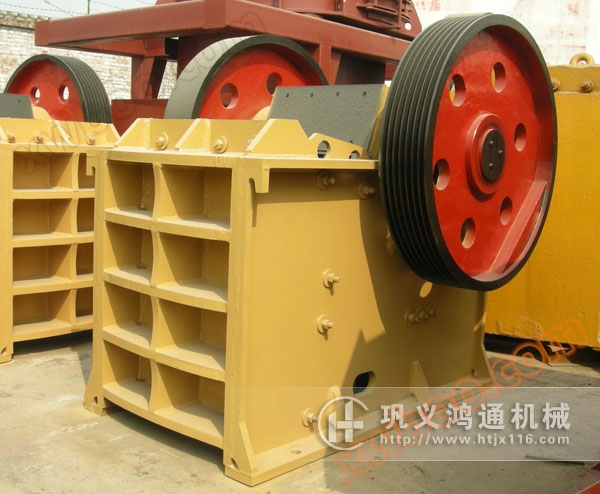
Structure of basalt crusher
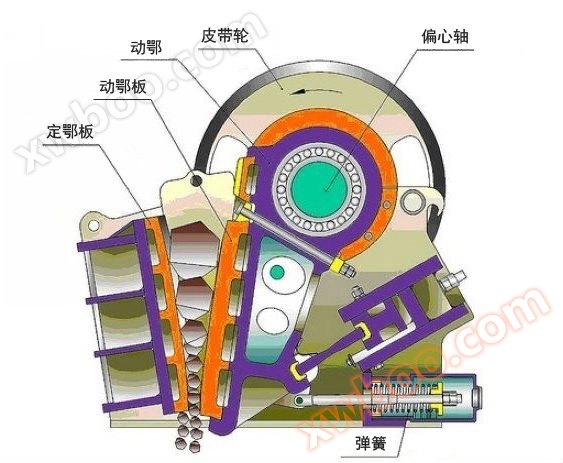
The structure of a basalt crusher mainly consists of a frame, eccentric shaft, large pulley, flywheel, movable jaw, side guard plate, elbow plate, elbow plate back seat, gap adjusting screw, reset spring, fixed jaw plate and movable jaw plate, among which the elbow plate also plays a safety role.
Working principle of basalt crusher
The crushing method of the basalt crusher is a curved extrusion type. The electric motor drives the belt and pulley, and the movable jaw moves up and down through an eccentric shaft. When the movable jaw rises, the angle between the elbow plate and the movable jaw increases, thereby pushing the movable jaw plate closer to the fixed jaw plate. At the same time, the basalt is crushed in multiple ways such as compression, rubbing, and grinding; When the moving jaw descends, the angle between the elbow plate and the moving jaw decreases, and the moving jaw plate moves away from the fixed jaw plate under the action of the pull rod and spring. At this time, the broken basalt is discharged from the lower mouth of the crushing chamber, and with the continuous rotation of the electric motor, the crusher moves the jaw for periodic crushing and discharging, achieving mass production.
Performance characteristics of basalt crusher
1. The Hongtong basalt crusher adopts world-class manufacturing technology and selects the highest end production materials.
2. The more advanced moving jaw assembly makes it more durable. The moving jaw assembly is made of high-quality cast steel parts and is driven by two large cast steel flywheels. In addition, the heavy-duty eccentric shaft is also processed with forged blanks, all of which make the jaw crusher have extraordinary reliability.
3. The bearing seat adopts an integral cast steel structure, which can ensure complete matching with the crusher frame and greatly enhance the radial strength of the bearing seat, while the split type bearing seat does not have this advantage.
4. The Hongtong basalt crusher adopts finite element analysis technology and has higher strength.
5. The crushing chamber of the basalt crusher adopts a symmetrical "V" - shaped structure, which ensures that the actual feeding port width is consistent with the nominal feeding port width.
6. Adjusting the discharge port is faster and more convenient. The basalt crusher is equipped with a wedge discharge port adjustment device, which is simpler, safer, and faster than the old-fashioned gasket adjustment.
7. Choose bearings with larger specifications and higher load-bearing capacity. The Hongtong basalt crusher is equipped with larger and more durable eccentric shaft bearings compared to other crushers of the same specifications. Its higher load-bearing capacity and effective labyrinth seal greatly extend the service life of the bearings.
8. The Hongtong basalt crusher adopts a toothed guard plate, which increases the effective length of the jaw plate and increases the output.
Technical parameters of basalt jaw crusher
Note: The equipment model parameters are constantly being improved. If you cannot find the required model in the parameter table, you can contact us directly. Our technicians will configure the equipment that best suits your production needs and site requirements according to your requirements.
Introduction to basalt impact crusher
The basalt impact crusher has a large feed inlet, high crushing chamber, high material hardness, large block size, and less product stone powder; The gap between the counterattack plate and the plate hammer can be easily adjusted, effectively controlling the particle size of the discharge and ensuring good particle shape; Compact structure, strong rigidity of the machine, and large rotational inertia of the rotor; High chromium plate hammer, resistant to impact, wear, and strong impact force; Keyless connection, easy maintenance, economical and reliable; Full crushing function, high productivity, minimal wear of mechanical parts, and high comprehensive benefits. Using this equipment to break difficult to break basalt can achieve twice the result with half the effort. This series of products can handle materials with a side length of 100-500 millimeters or less, with a maximum pressure resistance of 350 megapascals, and has the advantages of high crushing ratio, resulting in the material appearing as cubic particles after crushing.
Image of basalt impact crusher
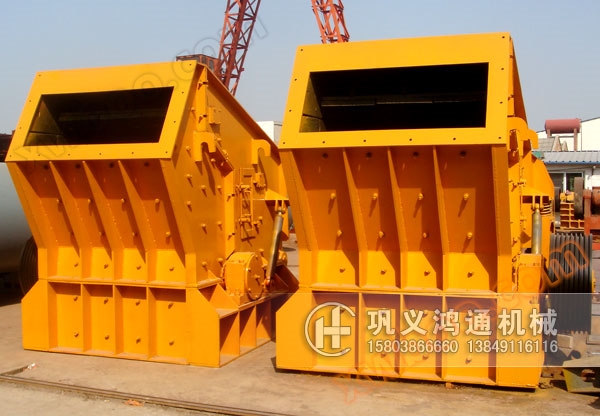
Structure of basalt crusher
The basalt crusher is mainly composed of: pull rod, front impact frame, rear impact frame, impact lining plate, main shaft, locking block, clamping plate, rotor frame, plate hammer, impact plate, rotor, etc.
Working principle of basalt crusher
The basalt is broken using impact energy. During operation, the rotor rotates at high speed under the drive of the electric motor. When the basalt enters the action zone of the plate hammer, it collides with the plate hammer on the rotor and is broken again. It is then thrown towards the counterattack device for further breakage, and then bounced back from the counterattack lining plate to the action zone of the plate hammer for further breakage. This process is repeated, and the basalt enters the first, second, third, and counterattack chambers from large to small for repeated breakage until it is broken to the desired particle size and discharged from the discharge port. Adjusting the gap between the counterattack frame and the rotor can achieve the goal of changing the particle size and shape of basalt discharge.

Advantages of basalt crusher
1、 破碎比大、能耗少
The crushing ratio of basalt crusher is very large. Generally, the maximum crushing ratio of basalt crusher does not exceed 10, while the crushing ratio of basalt crusher is 30-40, and the maximum can reach 150. High crushing efficiency and low energy consumption.
2. The product has uniform particle size and minimal over crushing
During the crushing process, useful minerals and gangue first rupture along the joint surface to facilitate unit separation of useful minerals, especially for coarse-grained embedded useful minerals, which is more significant. The product has uniform particle size and less over crushing phenomenon.
3. The basalt crusher has strong adaptability and can be used for multiple purposes
The particle size and shape of basalt crusher products are relatively good, making its application range more extensive. It can not only provide finer grained raw materials for ball mills, but also the best equipment for artificial sand making.
Common faults and solutions of basalt crusher
Basalt crushers often encounter some minor malfunctions in daily production, which require targeted treatment to be resolved in a timely manner. With years of experience accumulation, our Hongtong Machinery Factory in Gongyi City has summarized several common faults of basalt crushers for customers.
1. If it is found that the bearings of the basalt crusher are heating up
2. If abnormal vibration is found in the basalt crusher
3. If the belt of the basalt crusher is found to be overturned
4. If it is found that the discharged particles from the basalt crusher are too large
To learn more about common faults and solutions of basalt crushers, please clickCommon faults and solutions of basalt crusher
Technical parameters of basalt impact crusher
Note: The equipment model parameters are constantly being improved. If you cannot find the required model in the parameter table, you can contact us directly. Our technicians will configure the equipment that best suits your production needs and site requirements according to your requirements.
Production process of basalt crusher
1. The raw materials are fed uniformly by a vibrating feeder through a silo and transported to a basalt jaw crusher for coarse crushing.
2. The roughly broken granite is transported by a conveying device to a granite impact crusher for fine crushing.
3. The finely crushed stones are sieved by a vibrating screen to separate stones of different sizes. Stones that do not meet the particle size requirements are returned to the basalt impact crusher for further crushing.
4. The material screened by the vibrating screen is the finished product, which is transported to the storage pile by the belt conveyor.
The above process flow is the standard process of basalt crushing production line. But in actual production, it is necessary to equip appropriate equipment according to different customer production requirements.

Basalt is a good raw material for producing "cast stone". Cast stone "is a material made by melting, casting, crystallization, and annealing basalt. It is harder and more wear-resistant than alloy steel, and more corrosion-resistant than lead and rubber. Basalt still plays a role as a "lubricant" in an advanced steel casting process, which can extend the life of the casting film. At the same time, basalt can also be extracted into glass fiber, which has stronger alkali resistance and better high temperature resistance than ordinary glass fiber cloth. Among them, the porous basalt, also known as pumice, has many pores and a hard texture. It can be mixed into concrete to reduce the weight of the concrete. It is not only strong and durable, but also has the characteristics of sound insulation and thermal insulation. It is a good aggregate for lightweight concrete in high-rise buildings.
Basalt has excellent compressive and flexural properties, as well as good wear resistance and low water absorption. It is also a very good building decoration material, which can be widely used for indoor and outdoor decoration, and is mainly used as outdoor stone. Its natural color can coordinate well with the surrounding landscape, making it very suitable for outdoor landscape construction, especially as the best choice for floor stone. However, as mentioned earlier, basalt is prone to forming hexagonal columnar joints and is brittle, so the stone blocks are generally not large and lack large materials, making it difficult to produce large-sized slabs.
Basalt is the best material used for repairing highways, railways, and airport runways. It has strong compressive strength, low crushing value, strong corrosion resistance, and asphalt adhesion. Basalt has the advantages of wear resistance, low water consumption, poor electrical conductivity, strong compressive strength, low crushing value, strong corrosion resistance, and asphalt adhesion, and is internationally recognized as the best cornerstone for the development of railway and road transportation.
Introduction to basalt crusher
Basalt is a material with high hardness and silicon content, which is difficult to break or has high crushing costs in actual crushing operations. Simply put, basalt is a hard and tough material with a high silicon content. Therefore, the crushing process of basalt must be designed reasonably, taking into account both the investment cost of the crushing project and the production cost of the production line. In the basalt crushing production line, we usually use a jaw crusher as the first crushing process - coarse crushing, and an impact crusher as the second crushing process - fine crushing. However, in actual production, other crushing equipment can also be selected based on various factors such as material characteristics, particle size, discharge particle size, and crushing fineness. This needs to be configured specifically according to the customer's production requirements.
Introduction to Basalt Jaw Crusher
The basalt jaw crusher is mainly used for medium particle size crushing of various ores and large materials. It can crush materials with compressive strength not exceeding 320Mpa, and is divided into coarse and fine crushing. This series of products has complete specifications, with a feeding particle size of 600mm to 1500mm, making it the preferred equipment for primary crushing. Basalt jaw crushers are widely used in various industries such as mining, metallurgy, construction, highways, railways, water conservancy, chemical engineering, refractory materials, and ceramics. The basalt jaw crusher equipment has a simple structure, reliable operation, and low operating costs; The crushing chamber is deep and has no dead zone, which improves the feeding capacity and output; Large crushing ratio and uniform product particle size; The gasket type discharge port adjustment device is reliable and convenient, with a large adjustment range, which increases the flexibility of the equipment and can meet the requirements of different users; The lubrication system is safe and reliable, with easy component replacement and minimal maintenance workload; Equipment energy saving: Single unit energy saving of 15% to 30%, system energy saving of more than twice; Low noise and minimal dust. Due to these unique performance characteristics, it has significant advantages in crushing materials such as basalt that are difficult to break.
Image of Basalt Jaw Crusher
Structure of basalt crusher
The structure of a basalt crusher mainly consists of a frame, eccentric shaft, large pulley, flywheel, movable jaw, side guard plate, elbow plate, elbow plate back seat, gap adjusting screw, reset spring, fixed jaw plate and movable jaw plate, among which the elbow plate also plays a safety role.
Working principle of basalt crusher
The crushing method of the basalt crusher is a curved extrusion type. The electric motor drives the belt and pulley, and the movable jaw moves up and down through an eccentric shaft. When the movable jaw rises, the angle between the elbow plate and the movable jaw increases, thereby pushing the movable jaw plate closer to the fixed jaw plate. At the same time, the basalt is crushed in multiple ways such as compression, rubbing, and grinding; When the moving jaw descends, the angle between the elbow plate and the moving jaw decreases, and the moving jaw plate moves away from the fixed jaw plate under the action of the pull rod and spring. At this time, the broken basalt is discharged from the lower mouth of the crushing chamber, and with the continuous rotation of the electric motor, the crusher moves the jaw for periodic crushing and discharging, achieving mass production.
Performance characteristics of basalt crusher
1. The Hongtong basalt crusher adopts world-class manufacturing technology and selects the highest end production materials.
2. The more advanced moving jaw assembly makes it more durable. The moving jaw assembly is made of high-quality cast steel parts and is driven by two large cast steel flywheels. In addition, the heavy-duty eccentric shaft is also processed with forged blanks, all of which make the jaw crusher have extraordinary reliability.
3. The bearing seat adopts an integral cast steel structure, which can ensure complete matching with the crusher frame and greatly enhance the radial strength of the bearing seat, while the split type bearing seat does not have this advantage.
4. The Hongtong basalt crusher adopts finite element analysis technology and has higher strength.
5. The crushing chamber of the basalt crusher adopts a symmetrical "V" - shaped structure, which ensures that the actual feeding port width is consistent with the nominal feeding port width.
6. Adjusting the discharge port is faster and more convenient. The basalt crusher is equipped with a wedge discharge port adjustment device, which is simpler, safer, and faster than the old-fashioned gasket adjustment.
7. Choose bearings with larger specifications and higher load-bearing capacity. The Hongtong basalt crusher is equipped with larger and more durable eccentric shaft bearings compared to other crushers of the same specifications. Its higher load-bearing capacity and effective labyrinth seal greatly extend the service life of the bearings.
8. The Hongtong basalt crusher adopts a toothed guard plate, which increases the effective length of the jaw plate and increases the output.
Technical parameters of basalt jaw crusher
|
Specification Model |
feed inlet size |
Maximum entry |
Discharge port adjustment |
processing power |
偏心轴转速 (r/min) |
Motor power |
Total weight |
Overall dimensions |
|
PE-150×250 |
150×250 |
125 |
10-40 |
1-3 |
250 |
5.5 |
0.8 |
720×660×850 |
|
PE-200×300 |
200×300 |
180 |
15-50 |
2-6 |
260 |
7.5 |
1.2 |
910×750×990 |
|
PE-200×350 |
200×350 |
180 |
18-70 |
3-10 |
260 |
11 |
1.5 |
1000×870×990 |
|
PE-250×400 |
250×400 |
210 |
20-60 |
5-20 |
300 |
15 |
2.8 |
1300×1090×1270 |
|
PE-400×600 |
400×600 |
340 |
40-100 |
16-60 |
275 |
30 |
7 |
1730×1730×1630 |
|
PE-500×750 |
500×750 |
425 |
50-100 |
40-110 |
275 |
55 |
12 |
1980×2080×1870 |
|
PE-600×750 |
600×750 |
500 |
150-200 |
80-240 |
275 |
55 |
15.8 |
2070×2000×1920 |
|
PE-600×900 |
600×900 |
500 |
65-160 |
50-180 |
250 |
55 |
17 |
2190×2206×2300 |
|
PE-750×1060 |
750×1060 |
630 |
80-140 |
110-320 |
250 |
110 |
29 |
2660×2430×2800 |
|
PE-800×1060 |
800×1060 |
640 |
130-190 |
130-330 |
250 |
110 |
29.8 |
2710×2430×2800 |
|
PE-830×1060 |
830×1060 |
650 |
160-220 |
150-336 |
250 |
110 |
30.7 |
2740×2430×2800 |
|
PE-870×1060 |
870×1060 |
660 |
200-260 |
190-336 |
250 |
110 |
31.5 |
2810×2430×2800 |
|
PE-900×1060 |
900×1060 |
685 |
230-290 |
230-390 |
250 |
110 |
33 |
2870×2420×2940 |
|
PE-900×1200 |
900×1200 |
750 |
95-165 |
220-450 |
200 |
110 |
52 |
3380×2870×3330 |
|
PE-1000×1200 |
1000×1200 |
850 |
195-265 |
315-500 |
200 |
110 |
55 |
3480×2876×3330 |
|
PE-1200×1500 |
1200×1500 |
1020 |
150-350 |
400-800 |
180 |
160 |
100.9 |
4200×3300×3500 |
|
PE-1500×1800 |
1500×1800 |
1200 |
220-350 |
500-1000 |
180 |
280 |
122 |
5160×3660×4248 |
|
PE-1800×2100 |
1800×2100 |
1500 |
300-400 |
600-1200 |
160 |
400 |
150.6 |
6210×4013×4716 |
|
PEX-150×750 |
150×750 |
120 |
18-48 |
8-25 |
320 |
15 |
3.8 |
1200×1530×1060 |
|
PEX-250×750 |
250×750 |
210 |
25-60 |
13-35 |
330 |
30 |
5.5 |
1380×1750×1540 |
|
PEX-250×1000 |
250×1000 |
210 |
25-60 |
16-52 |
330 |
30 |
7 |
1560×1950×1390 |
|
PEX-250×1200 |
250×1200 |
210 |
25-60 |
20-61 |
330 |
37 |
9.7 |
2140×1660×1500 |
|
PEX-300×1300 |
300×1300 |
250 |
20-90 |
16-105 |
300 |
55 |
15.6 |
2720×1950×1600 |
Introduction to basalt impact crusher
The basalt impact crusher has a large feed inlet, high crushing chamber, high material hardness, large block size, and less product stone powder; The gap between the counterattack plate and the plate hammer can be easily adjusted, effectively controlling the particle size of the discharge and ensuring good particle shape; Compact structure, strong rigidity of the machine, and large rotational inertia of the rotor; High chromium plate hammer, resistant to impact, wear, and strong impact force; Keyless connection, easy maintenance, economical and reliable; Full crushing function, high productivity, minimal wear of mechanical parts, and high comprehensive benefits. Using this equipment to break difficult to break basalt can achieve twice the result with half the effort. This series of products can handle materials with a side length of 100-500 millimeters or less, with a maximum pressure resistance of 350 megapascals, and has the advantages of high crushing ratio, resulting in the material appearing as cubic particles after crushing.
Image of basalt impact crusher
Structure of basalt crusher
The basalt crusher is mainly composed of: pull rod, front impact frame, rear impact frame, impact lining plate, main shaft, locking block, clamping plate, rotor frame, plate hammer, impact plate, rotor, etc.
Working principle of basalt crusher
The basalt is broken using impact energy. During operation, the rotor rotates at high speed under the drive of the electric motor. When the basalt enters the action zone of the plate hammer, it collides with the plate hammer on the rotor and is broken again. It is then thrown towards the counterattack device for further breakage, and then bounced back from the counterattack lining plate to the action zone of the plate hammer for further breakage. This process is repeated, and the basalt enters the first, second, third, and counterattack chambers from large to small for repeated breakage until it is broken to the desired particle size and discharged from the discharge port. Adjusting the gap between the counterattack frame and the rotor can achieve the goal of changing the particle size and shape of basalt discharge.
Advantages of basalt crusher
1、 破碎比大、能耗少
The crushing ratio of basalt crusher is very large. Generally, the maximum crushing ratio of basalt crusher does not exceed 10, while the crushing ratio of basalt crusher is 30-40, and the maximum can reach 150. High crushing efficiency and low energy consumption.
2. The product has uniform particle size and minimal over crushing
During the crushing process, useful minerals and gangue first rupture along the joint surface to facilitate unit separation of useful minerals, especially for coarse-grained embedded useful minerals, which is more significant. The product has uniform particle size and less over crushing phenomenon.
3. The basalt crusher has strong adaptability and can be used for multiple purposes
The particle size and shape of basalt crusher products are relatively good, making its application range more extensive. It can not only provide finer grained raw materials for ball mills, but also the best equipment for artificial sand making.
Common faults and solutions of basalt crusher
Basalt crushers often encounter some minor malfunctions in daily production, which require targeted treatment to be resolved in a timely manner. With years of experience accumulation, our Hongtong Machinery Factory in Gongyi City has summarized several common faults of basalt crushers for customers.
1. If it is found that the bearings of the basalt crusher are heating up
2. If abnormal vibration is found in the basalt crusher
3. If the belt of the basalt crusher is found to be overturned
4. If it is found that the discharged particles from the basalt crusher are too large
To learn more about common faults and solutions of basalt crushers, please clickCommon faults and solutions of basalt crusher
Technical parameters of basalt impact crusher
|
model |
Specifications |
feed inlet size |
Maximum Feed |
production capacity |
power |
Total weight |
Dimensions (mm) |
|
PF-1007 |
Φ1000×700 |
400×730 |
300 |
30-70 |
45 |
12 |
2330×1660×2300 |
|
PF-1010 |
Φ1000×1050 |
400×1080 |
350 |
50-90 |
55 |
15 |
2370×1700×2390 |
|
PF-1210 |
Φ1250×1050 |
400×1080 |
350 |
70-130 |
110 |
17.7 |
2680×2160×2800 |
|
PF-1214 |
Φ1250×1400 |
400×1430 |
350 |
100-180 |
132 |
22.4 |
2650×2460×2800 |
|
PF-1315 |
Φ1320×1500 |
860×1520 |
500 |
130-250 |
220 |
27 |
3180×2720×2620 |
|
PF-1520 |
Φ1500×2000 |
830×2040 |
700 |
300-550 |
440 |
50.6 |
3959×3564×3330 |
Production process of basalt crusher
1. The raw materials are fed uniformly by a vibrating feeder through a silo and transported to a basalt jaw crusher for coarse crushing.
2. The roughly broken granite is transported by a conveying device to a granite impact crusher for fine crushing.
3. The finely crushed stones are sieved by a vibrating screen to separate stones of different sizes. Stones that do not meet the particle size requirements are returned to the basalt impact crusher for further crushing.
4. The material screened by the vibrating screen is the finished product, which is transported to the storage pile by the belt conveyor.
The above process flow is the standard process of basalt crushing production line. But in actual production, it is necessary to equip appropriate equipment according to different customer production requirements.
Process flow of basalt crushing production line
Previous: Granite crusher prices, rock crusher manufacturers, granite crusher equipment production lines
Next article: Sand and stone crusher, stone crusher, sand and stone crusher, sand and stone crushing equipment, sand and stone production line equipment
Next article: Sand and stone crusher, stone crusher, sand and stone crusher, sand and stone crushing equipment, sand and stone production line equipment
latest articles
- How much is a 1500 × 800 hydraulic roller crusher?
- Is the roller crusher easy to use?
- How to choose a good manufacturer when purchasing a roller crusher?
- Large Roll Sand Making Machine Video _ Fully Automatic Hydraulic Roll Sand Making Machine Production Video
- Professional roller crushing sand production base, all at Hongtong Machinery!
- Which roller crusher should I choose? Take a look at Hongtong Machinery, a professional sand crusher factory
- The peak season discount for roller crushers is something you can't imagine!
- Professional hydraulic roller crusher manufacturer! Gansu people, hurry up and take a look!
- Which roller crusher should I choose? Take a look at Hongtong Machinery, a professional sand crusher factory
- Assist in the reuse of national resources! Roll crushers are currently in short supply!
View all related articles>>
expert consultation
-

-
100% high-quality raw materials for the product
Quality is guaranteed.
-

-
Fast delivery
Production is guaranteed
-

-
Track installation and debugging throughout the process
After sales guarantee
Kind reminder: If you are interested in our products, you can call us immediately!
Sales Service Hotline: