-
E-mail
925633677@qq.com
-
Phone
15051989720
-
Address
Sanhekou Industrial Park, Zhenglu Town, Changzhou
Product Categories
Changzhou Xianzhu Drying Equipment Co., Ltd
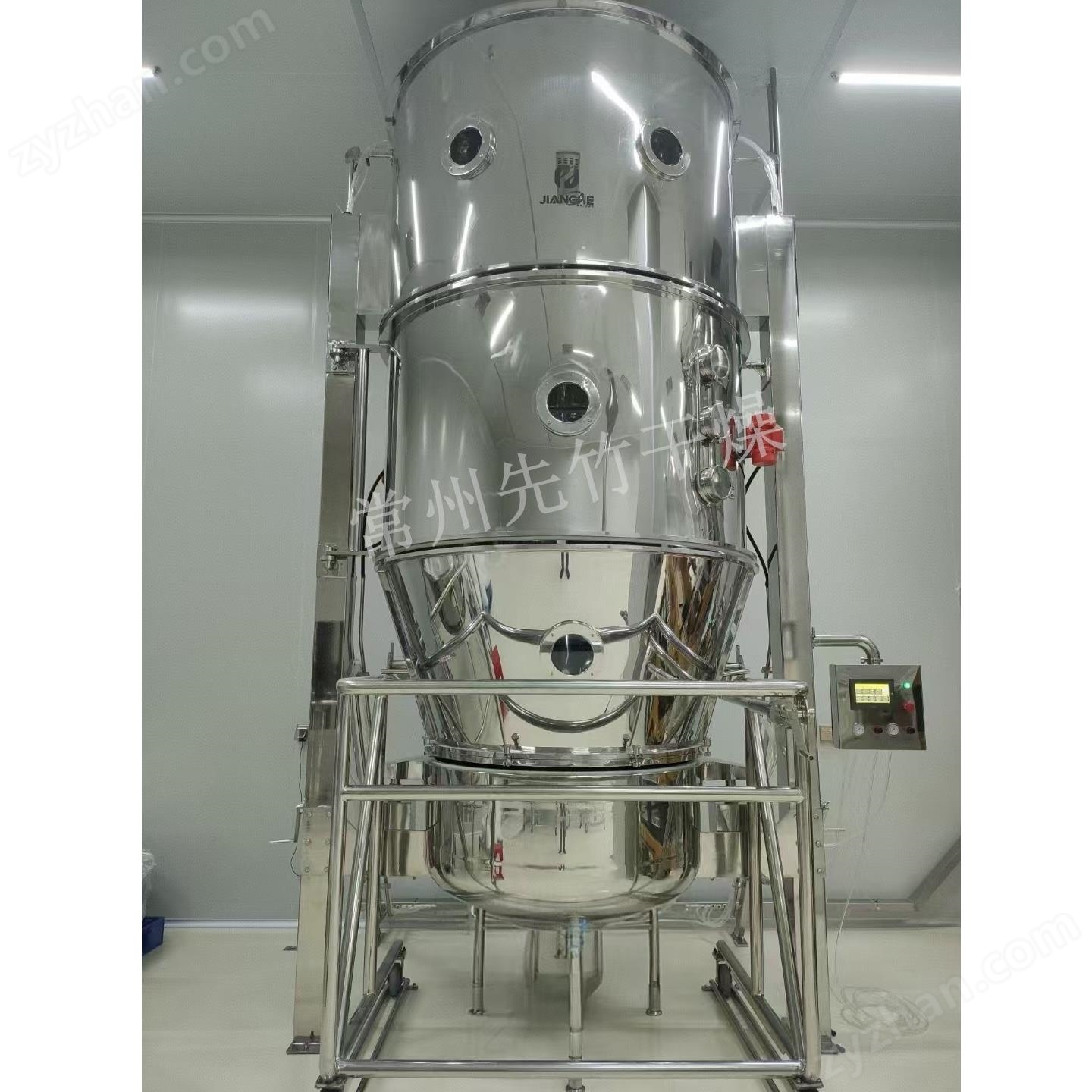


Customization of Boiling Drying Equipment
NegotiableUpdate on 02/16
- Model
- Nature of the Manufacturer
- Producers
- Product Category
- Place of Origin
Overview
Boiling drying equipment uses hot air or other fluids to bring material particles into a boiling state in the bed, thereby achieving efficient heat and mass transfer processes, and achieving rapid drying, cooling, and granulation. It is widely used in various industries such as pharmaceuticals, food, chemicals, and feed.
Product Details
1、 Product Overview
Boiling drying equipment uses hot air or other fluids to bring material particles into a boiling state in the bed, thereby achieving efficient heat and mass transfer processes, and achieving rapid drying, cooling, and granulation. It is widely used in various industries such as pharmaceuticals, food, chemicals, and feed.
2、 Working principle
The material enters the fluidized bed drying host through the feeding device, and after being distributed by the distribution plate, it forms a boiling suspension state under the action of hot air. During this process, the material comes into full contact with the heat medium, and the moisture evaporates rapidly, achieving drying. For wet materials, a finned pre dryer can first use high-temperature airflow to instantly remove some moisture, and then enter a fluidized bed for deep drying. The dried material is discharged from the discharge port, while the exhaust gas with dust is discharged after two-stage dust removal treatment by a cyclone separator and a bag filter to ensure environmental compliance.
3、 Structural Design
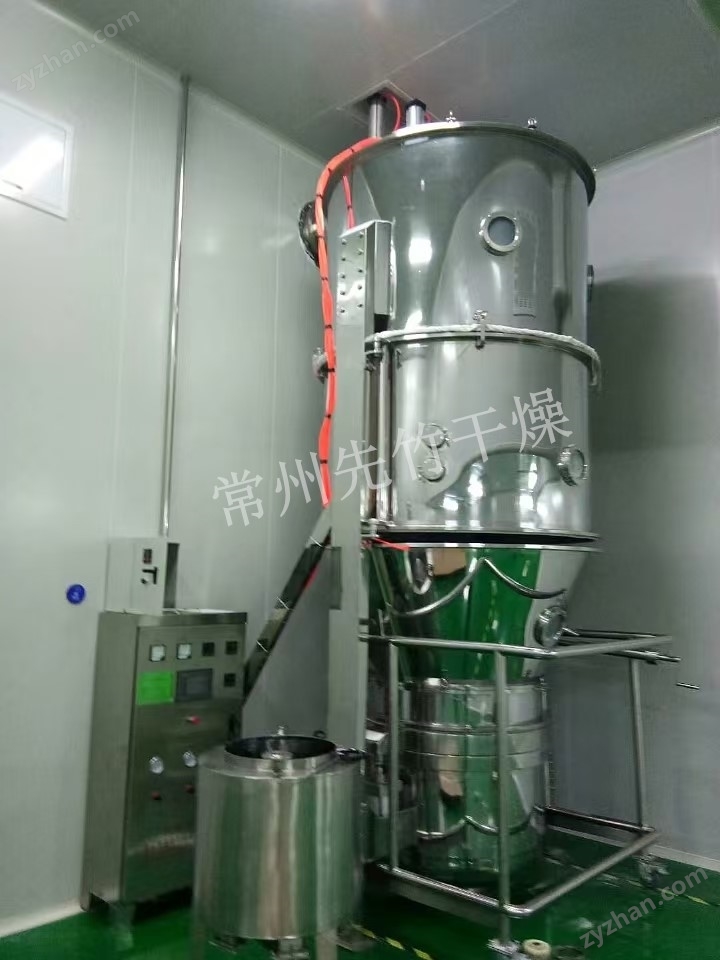
Fluidized bed host: It is the core component with distribution plates inside, which can evenly distribute materials and form a good fluidized state. The bed adopts a specially designed flower board as a support to ensure the stability of the overall structure and facilitate installation and maintenance. In addition, it is equipped with quick opening cleaning holes and sight glasses, which facilitate operators to clean and observe the inside of the equipment to meet the production needs of different types of materials and comply with GMP standards.
Heat exchanger: located at the bottom of the bed, using methods such as electric heating or steam heating to provide a stable heat source for the drying process. Its design ensures efficient heat transfer, allowing hot air to evenly act on the material and improve drying efficiency.
Feeding system: including raw material containers, vacuum feeding pipelines, feeding valves, and atomizing spray guns. This part can achieve automatic quantitative feeding and evenly spray liquid materials into solid powder after atomization, which is beneficial for the subsequent granulation process.
Induced draft unit: mainly composed of centrifugal fans and air ducts, responsible for extracting moisture and dust generated during the drying process. Reasonable air duct design and air volume control help maintain a suitable air pressure difference in the bed, promote the normal flow of materials, and improve the drying effect.
Control system: Generally, PLC+touch screen human-machine interface is used for automation control. Operators can easily set various process parameters such as temperature, pressure, flow rate, time, etc. through the touch screen, monitor the real-time operation status of the equipment, and make adjustments as needed. This intelligent control method not only improves production efficiency, but also reduces labor intensity and ensures the stability of product quality.
4、 Functional Features
Efficient and energy-saving: Due to the high heat and mass transfer coefficients between materials and heat media, it is possible to complete the drying task of a large amount of materials in a short period of time, greatly improving production efficiency. Meanwhile, optimized structural design and reasonable energy recovery measures have effectively reduced energy consumption and lowered production costs.
Good drying quality: In boiling state, the material particles are uniformly heated, avoiding local overheating and ensuring consistent moisture content and quality stability of the product. Moreover, the entire drying process is gentle and can adapt well to some heat sensitive materials, making it less likely to cause material deterioration or damage.
Multi functional integration: In addition to the basic drying function, different auxiliary devices can be configured according to user needs to achieve continuous operation of multiple processes such as cooling, drying, granulation, coating, etc. on the same equipment, meeting diverse production requirements and reducing equipment investment and footprint.
Flexible and convenient operation: Various parameters can be freely adjusted according to the characteristics of materials and the requirements of production processes, such as inlet air temperature, air volume, residence time, etc., to achieve drying effect. In addition, the start-up and shutdown operations of the equipment are simple and fast, which can quickly respond to changes in production plans and adapt to the needs of multi batch and small batch production.
Good airtightness: The entire system operates under negative pressure, effectively preventing dust leakage and cross contamination, improving the working environment, and ensuring the physical health of operators. At the same time, it also meets the strict requirements of modern industrial production for green environmental protection and safety production.
Easy to clean and maintain: All major components adopt modular design, making disassembly and assembly convenient. Especially for key parts such as filters and spray guns, there are dedicated cleaning channels and maintenance entrances, making daily maintenance work easier and more efficient, and extending the service life of the equipment.
5、 Scope of application of boiling drying equipment
Pharmaceutical industry: suitable for drying and sterilizing various pharmaceutical raw materials, as well as drying and granulation of traditional Chinese medicine extracts. It can also be used for fine processing such as slow-release granules, controlled release granules, and small pill coating, meeting the strict quality standards of drug production.
In the food industry, it can be used for dehydration and drying of products such as grains, fruits and vegetables, dairy products, seasonings, etc., to maintain the nutritional content without loss, while giving the products a good appearance, shape, and taste.
Chemical industry: suitable for processing various powder and granular chemicals such as dyes, pigments, plastic resins, pesticides, etc., which can accelerate reaction rates and improve the quality and flowability of finished products.
Other industries such as ceramic materials, metallurgical powders, and electronic components are also suitable for drying small particle materials to achieve high-quality production processes.

3、 Main structural components
1. Host system
Fluidized bed chamber: usually cylindrical or square stainless steel container, with mirror polished inner walls for easy cleaning.
Air intake system: including primary, medium, and high-efficiency (HEPA) three-stage filters to ensure high cleanliness of the incoming air; Equipped with heaters (electric heating, steam or hot water) for precise temperature control.
Exhaust system: An induced draft fan is installed at the top to maintain a slight negative pressure in the chamber; After dust removal and filtration, the exhaust meets the emission standards.
2. Filtering and cleaning system
Adopting anti-static coated filter bags or foldable filter cartridges;
Equipped with an automatic pulse back blowing dust cleaning device (compressed air timed blowing) to prevent filter material blockage and ensure stable airflow.
3. Control system
PLC+industrial touch screen human-machine interface, supporting process parameter setting (inlet temperature, air volume, drying time, etc.), operation curve recording, and alarm management;
Some models integrate PAT (Process Analysis Technology) interfaces, which can be connected to online moisture detectors, temperature probes, etc., to achieve intelligent endpoint judgment;
4. Auxiliary function module (optional)
Top spray granulation/coating system: used for one-step granulation or sustained-release coating;
Bottom spray system: realizing pellet coating, suitable for multi unit drug delivery systems;
Cooling section: After drying, directly cool the particles to avoid moisture absorption and agglomeration.
4、 Product features and technological advantages
1. High drying efficiency
Under fluidized state, the contact area between particles and hot air is larger, and the drying rate is faster than that of box drying.
2. Excellent particle quality
After drying, the particles are loose, porous, have good flowability, and are not easily clumped;
The particle size distribution remains stable, suitable for subsequent compression or capsule filling.
3. Accurate temperature control
Avoid degradation of heat sensitive ingredients such as enzymes, vitamins, and probiotics.
4. Closed operation, in compliance with GMP
Fully enclosed structure+negative pressure design, effectively preventing dust dispersion and cross contamination; Support online cleaning and online sterilization.
5. Multi functional integration
One device can achieve four in one drying, granulation, coating, and cooling, reducing material transfer and improving production efficiency and compliance.
6. Energy conservation and environmental protection
High thermal energy utilization rate, some models are equipped with heat recovery devices, reducing energy consumption by more than 20%.