-
E-mail
925633677@qq.com
-
Phone
15051989720
-
Address
Sanhekou Industrial Park, Zhenglu Town, Changzhou
Product Categories
Changzhou Xianzhu Drying Equipment Co., Ltd


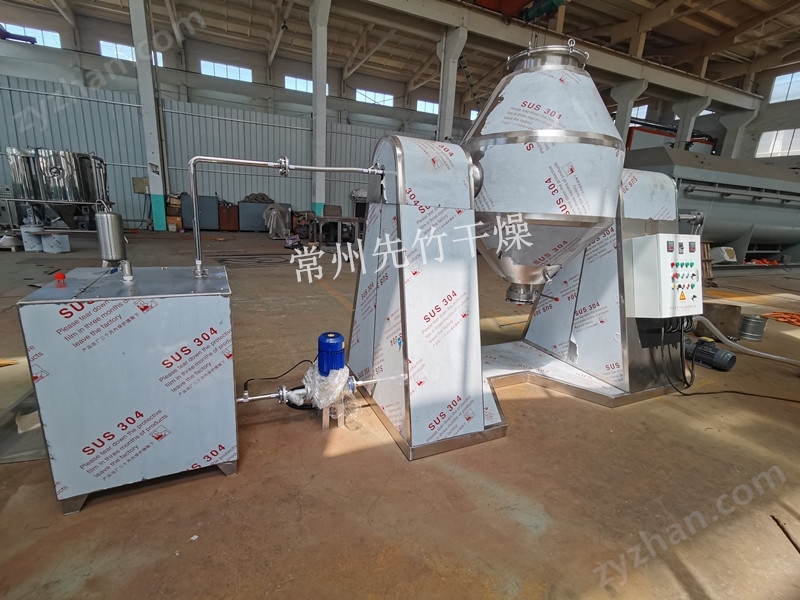
Experimental rotary vacuum dryer
NegotiableUpdate on 01/05
- Model
- Nature of the Manufacturer
- Producers
- Product Category
- Place of Origin
Overview
The effective volume of experimental rotary vacuum dryers is usually 1L to 20L, suitable for scientific research and small-scale production needs with a single processing capacity of 50g to 5kg. Its core value lies in significantly improving drying efficiency and uniformity while protecting material activity. Compared to static drying, the drying time can be shortened, and the finished product is loose, free of clumps, and has good flowability, making it particularly suitable for subsequent tablet pressing, packaging, or analytical testing.
Product Details
Product Introduction of Experimental Rotary Vacuum Drying Machine
Efficient, uniform, and controllable drying treatment of small amounts of high-value, thermosensitive, or easily oxidizable materials is a key prerequisite for successful experiments and process scaling in drug development, fine chemical engineering, food science, new material synthesis, and university research. In response to the problems of long drying cycles, uneven heat transfer, and material agglomeration in traditional static vacuum drying ovens, we have introducedExperimental rotary vacuum dryer——A dynamic vacuum drying equipment designed specifically for laboratory and pilot stages. This device achieves a mild, fast, and pollution-free drying effect through a triple collaborative mechanism of "rotation+vacuum+jacket heating", and is widely used for small batch processing of paste, powder, crystal, and slurry materials.
1、 Equipment Overview and Core Values
The effective volume of experimental rotary vacuum dryers is usually 1L to 20L, suitable for scientific research and small-scale production needs with a single processing capacity of 50g to 5kg. Its core value lies in:Significantly improve drying efficiency and uniformity while protecting material activityCompared to static drying, the drying time can be shortened, and the finished product is loose, free of clumps, and has good flowability, making it particularly suitable for subsequent tablet pressing, packaging, or analytical testing.
Typical applications include:
- Pharmaceutical R&DLow temperature dehydration of antibiotic intermediates, peptides, protein freeze-drying concentrates, and traditional Chinese medicine extraction extracts;
- chemical synthesisSolvent removal of catalysts, metal organic frameworks, and precursors for lithium-ion cathode materials;
- Food and Health ProductsGentle drying of natural pigments, probiotic concentrates, and plant essential oil microcapsules;
- Universities and testing institutionsPreparation of standard samples, pre-treatment for trace analysis, and validation of new material properties.
2、 Working principle and structural characteristics
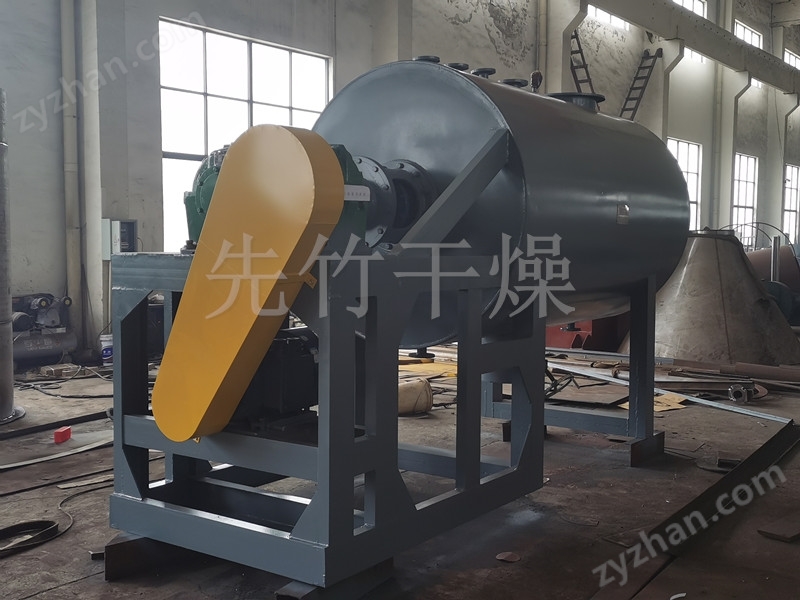
The main body of the equipment is a jacketed cylinder (also known as a "double cone" or "drum shaped" cavity) that can slowly rotate around an axis. During operation, it rotates at low speed in a high vacuum environment, causing the internal materials to continuously roll and update the heating surface, enhancing heat conduction and water evaporation.
The main components include:
- Rotating tank bodyMade of SUS316L stainless steel, with mirror polished inner walls and an effective capacity of 1L/5L/10L/20L available for selection;
- drive systemExplosion proof deceleration motor drives the tank to rotate at low speed, running smoothly and with low noise;
- heating systemInsert hot water, steam, or electrically heated thermal oil into the jacket;
- vacuum systemStandard dual stage rotary vane vacuum pump, optional condensation recovery device for efficient recovery of organic solvents such as ethanol and acetone;
- Sealing and supportDouble end mechanical seal and packing seal provide dual protection to ensure long-term no leakage under high vacuum; Bearing seat with lubrication and cooling structure, long service life;
- control systemIntelligent instrument integrates temperature, vacuum degree, and time control, with precision models equipped with PLC+touch screen, supporting programmed temperature rise, automatic shutdown, and data recording.
3、 Product advantages and technological innovation
-
Dynamic drying, uniform and efficient
The rotation of the tank body causes the material to continuously flip, avoiding local overheating or "dry outside and wet inside", and the drying uniformity far exceeds that of a static oven. For viscous paste, it can form loose particles instead of hard lumps, greatly improving the convenience of subsequent processing. -
Low temperature operation to protect activity
In a vacuum environment, the boiling point of water or solvents is significantly reduced, and the material can be dried at 40-80 ℃, effectively preventing the degradation or oxidation of thermosensitive components. -
Fully enclosed design, safe and environmentally friendly
- The whole machine operates without opening, suitable for toxic, odorous or highly allergenic materials;
- Can be filled with nitrogen to create an inert atmosphere, preventing oxidation and deterioration;
- Equipped with an efficient condenser, the organic solvent recovery rate is high, reducing emissions and raw material losses.
-
Compact structure, easy to operate
- Small footprint, can be placed next to the experimental bench or in a fume hood;
- Quick opening clamp or flange connection, easy to clean and maintain;
- The tank can be tilted electrically or manually for easy discharge.
4、 Typical technical parameters (SZG series double cone rotary vacuum dryer)
| Name/Specification | 100 | 350 | 500 | 750 | 1000 |
| internal volume of the can | 100 | 350 | 500 | 750 | 1000 |
| Loading capacity (L) | ≤50 | ≤175 | ≤250 | ≤375 | ≤500 |
| Heating area (m2) | 1.16 | 2 | 2.63 | 3.5 | 4.61 |
| Rotational speed (rpm) | 4 - 6 | ||||
| Motor power (kw) | 0.75 | 1.1 | 1.5 | 2 | 3 |
| Floor Area Length x Width (mm) | 2160×800 | 2260×800 | 2350×800 | 2560×1000 | 2860×1300 |
| Rotation height (mm) | 1750 | 2100 | 2250 | 2490 | 2800 |
| Design pressure inside the tank (Mpa) | -0.1-0.15 | ||||
| Design pressure of jacket (Mpa) | ≤0.3 | ||||
| Working temperature (oC) | Can interior ≤ 85, jacket ≤ 140 | ||||
| When using a condenser, a vacuum pump, | 2X-15A | 2X-15A | 2X-30A | 2X-30A | 2X-70A |
| Model, power | 2KW | 2KW | 3KW | 3KW | 505KW |
| When not using a condenser, a vacuum pump, | SK-0.4 | SK-0.8 | SK-0.8 | SK-2.7B | SK-2.7B |
| Model, power | 1.5KW | 2.2KW | 2.2KW | 4KW | 4KW |
| Weight (kg) | 800 | 1100 | 1200 | 1500 | 2800 |
| Name/Specification | 1500 | 2000 | 3500 | 4500 | 5000 |
| internal volume of the can | 1500 | 2000 | 3500 | 4500 | 5000 |
| Loading capacity (L) | ≤750 | ≤1000 | ≤1750 | ≤2250 | ≤2500 |
| Heating area (m2) | 5.58 | 7.5 | 11.2 | 13.1 | 14.1 |
| Rotational speed (rpm) | 4 - 6 | ||||
| Motor power (kw) | 3 | 4 | 5.5 | 7.5 | 11 |
| Floor Area Length x Width (mm) | 3060×1300 | 3260×1400 | 3760×1800 | 3960×2000 | 4400×2500 |
| Rotation height (mm) | 2940 | 2990 | 3490 | 4100 | 4200 |
| Design pressure inside the tank (Mpa) | -0.1-0.15 | ||||
| Design pressure of jacket (Mpa) | ≤0.3 | ||||
| Working temperature (oC) | -0.1-0.15 | ||||
| When using a condenser, a vacuum pump, | JZJX300-8 | JZJX300-4 | JZJX600-8 | JZJX600-4 | JZJX300-4 |
| Model, power | 7KW | 9.5KW | 11KW | 20.5KW | 22KW |
| When not using a condenser, a vacuum pump, | SK-3 | SK-6 | SK-6 | SK-9 | SK-10 |
| Model, power | 5.5KW | 11KW | 11KW | 15KW | 18.5KW |
| Weight (kg) | 3300 | 3600 | 6400 | 7500 | 8600 |
Note: For materials with significant volume changes before and after drying, the loading coefficient can be appropriately increased or decreased.