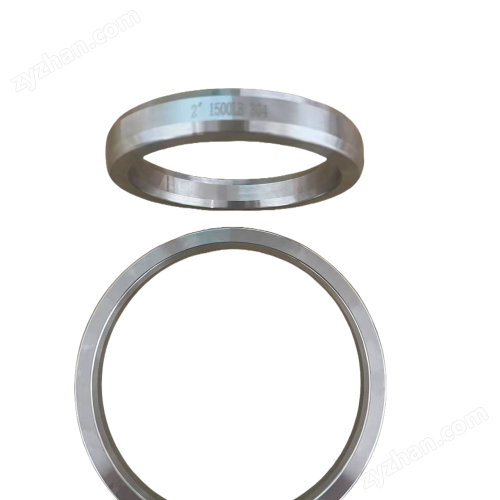
The HGT20633 flange is equipped with metal ring gaskets, octagonal gaskets, and octagonal gaskets installed in the trapezoidal ring grooves on the flange surface. When the connecting bolts are tightened, the octagonal gaskets are compressed under axial pressure. Due to its material (such as metal) having a certain degree of plasticity, it will undergo plastic deformation under pressure and closely adhere to the inner wall (including the side and bottom surfaces) of the trapezoidal groove, filling the small gap between the flange groove and the gasket, forming the initial sealing band. At this point, sufficient sealing pressure is generated on the contact surface between the gasket and the flange groove to prevent medium leakage.
HGT20633 flange metal ring gasket octagonal gasket
The sealing performance of octagonal gaskets is influenced by multiple factors, including material characteristics, structural design, installation operation, and working conditions, as follows:
1、 The influence of material properties
Material strength and plasticity
The octagonal gasket needs to have a certain plasticity to deform during compression and fill the gap between the flange grooves; At the same time, it needs to have sufficient strength to resist the long-term effects of medium pressure and bolt load. If the plasticity is insufficient, it is difficult to form a tight fit; Insufficient strength may result in excessive deformation or fracture under high pressure, leading to seal failure.
For example, carbon steel material has good plasticity but weak corrosion resistance, and is suitable for low-pressure and room temperature working conditions; Nickel based alloys have balanced plasticity and strength, and are resistant to high and low temperatures, corrosion, and are more suitable for harsh environments.
material hardness
The hardness of the octagonal gasket should be 15-20HB lower than the hardness of the flange surface (Brinell hardness), otherwise it will scratch the sealing surface of the flange and damage the sealing performance; If the hardness is too low, it may cause excessive insertion into the flange groove during compression, resulting in gasket failure or inability to be reused.
Corrosion resistance and temperature resistance
The corrosiveness of the medium (such as acidity or alkalinity) and temperature fluctuations (high temperature oxidation or low temperature embrittlement) can affect the stability of the material. If the corrosion resistance of the material is insufficient, holes or surface damage may occur due to corrosion; Insufficient temperature resistance may lead to material softening (high temperature) or embrittlement (low temperature), and damage to the sealing pressure ratio.
2、 The influence of structure and dimensional accuracy
Section shape and dimensional tolerance
The octagonal cross-section of the octagonal pad needs to be accurately matched with the flange trapezoidal groove (such as angle, side length, thickness, etc.). If the size deviation is too large (such as the side length being too long to fit into the groove, or the angle not matching causing a decrease in contact area), it will reduce the fit between the gasket and the flange groove, and cannot form an effective sealing tape.
surface roughness
The surface of the octagonal pad needs to maintain a certain degree of smoothness (usually Ra ≤ 1.6 μ m). If the surface roughness is too high and there are scratches, burrs, or indentations, it will cause the small gaps between the bonding surfaces to be unable to be filled by plastic deformation, becoming channels for medium leakage
3、 The impact of installation and operation
bolt preload
Insufficient pre tightening force: The octagonal gasket cannot produce sufficient plastic deformation, does not fit tightly with the flange groove, has insufficient sealing pressure, and the medium is prone to leakage from the gap.
Excessive pre tightening force: may cause excessive plastic deformation of the gasket, even crushing or embedding into the flange groove, damaging the gasket structure; At the same time, it may cause warping and deformation of the flange, which may actually reduce the sealing performance.
It is necessary to calculate and control the bolt pre tightening force based on the working conditions (pressure, temperature) to ensure that the sealing pressure is within a reasonable range.
Flange groove machining accuracy
The angle, depth, and surface roughness of the flange trapezoidal groove need to match the octagonal pad. If there are scratches, deformations, or angular deviations on the groove surface, it will cause uneven contact between the gasket and the groove surface, insufficient local sealing pressure, and lead to leakage.
Installation cleanliness
If there are impurities (such as oil stains, rust, particles) on the surface of the flange groove or octagonal gasket before installation, they will be embedded in the gasket or flange surface during compression, which will damage the sealing and even cause local stress concentration and damage to the gasket.
4、 The influence of working conditions
Medium pressure and temperature
Pressure fluctuation: In the short term, a sudden increase in pressure may cause slight separation between the gasket and the flange groove. If the gasket has insufficient elasticity and cannot rebound and compensate in a timely manner, instantaneous leakage may occur; Long term high pressure may cause the gasket to lose its plasticity due to fatigue.
Temperature changes: High temperatures can cause metal materials to creep, resulting in a decrease in sealing pressure; Sudden temperature changes (such as alternating hot and cold) can generate additional stress due to the difference in thermal expansion and contraction coefficients between the gasket and the flange, which can damage the bonding state.
medium characteristics
The viscosity, permeability, and corrosiveness of the medium can affect the sealing effect. Low viscosity media (such as gases) have strong permeability and require higher adhesion to the sealing surface; Corrosive media can erode gaskets or flange surfaces through small gaps, gradually expanding the leakage channel.
-

HGT20633 flange metal ring gasket octagonal gasket
5、 The impact of repeated use
Although the octagonal gasket can be reused, after multiple disassembly and assembly, its surface may be damaged due to wear and deformation, and the accumulation of plastic deformation will reduce the fitting accuracy between the gasket and the flange groove, gradually weakening the sealing performance. Therefore, before reuse, it is necessary to check the surface condition and dimensional changes of the gasket, and replace it with a new gasket if necessary.
comprehensiveThe sealing performance of the octagonal gasket is the result of the synergistic effect of multiple factors such as material, structure, installation, and working conditions. In practical applications, it needs to be comprehensively optimized according to specific conditions to ensure its reliability in harsh environments such as high temperature and high pressure.
The aging or damage of octagonal gaskets is mainly caused by the continuous destruction of their material properties, structural integrity, and sealing status under working conditions. The following types of working conditions will significantly accelerate this process:
1、 Temperature environment
Long term high temperature
When the temperature exceeds the material's tolerance limit (such as carbon steel exceeding 425 ℃, stainless steel 304 exceeding 650 ℃), the metal material will undergo creep (slow plastic deformation under continuous stress at high temperature), causing the sealing pressure of the octagonal gasket to gradually decrease and the fit with the flange groove to weaken. At the same time, high temperature may cause material oxidation (such as the formation of oxide scale on the surface of carbon steel), resulting in cracks or peeling on the gasket surface, and damaging the integrity of the sealing surface.
For example, in boiler steam pipelines, long-term high temperatures above 800 ℃ can cause carbon steel octagonal gaskets to fail due to excessive creep.
Frequent temperature fluctuations
The alternating cold and hot working conditions (such as intermittent operation of reaction vessels) will cause additional stress on the octagonal gasket and flange due to the difference in thermal expansion and contraction coefficients. After multiple cycles, the gasket may develop micro cracks due to fatigue or loosen the mating surface with the flange groove, resulting in seal failure.
2、 High pressure and severe pressure fluctuations
Continuous action of ultra-high pressure
When the system pressure exceeds the design pressure range of the octagonal gasket (such as exceeding 42MPa), the gasket will accumulate plastic deformation due to excessive radial expansion, and even "bite" with the flange groove, resulting in gasket fracture or inability to be reused during disassembly.
Sudden increase and decrease in pressure
Fluctuations in wellhead pressure during oil extraction and sudden pressure changes in chemical reaction vessels can cause instantaneous impact loads between the octagonal gasket and the flange groove. Repeated pressure shocks can cause fatigue wear on the gasket surface, or make the sealing pressure unstable, forming a leakage channel.
3、 Corrosive medium erosion
Strong corrosive medium
When the medium is a strong acid (such as hydrochloric acid, nitric acid), strong alkali (such as sodium hydroxide solution), or a fluid containing chloride ions or sulfides, if the corrosion resistance of the octagonal pad material is insufficient (such as when carbon steel is in contact with acidic media), chemical corrosion will occur:
Corrosion pits form on the surface, damaging the flatness of the sealing surface;
The strength of the material decreases after erosion, making it unable to withstand bolt pre tightening force and medium pressure, resulting in gasket fracture.
intergranular corrosion
Under specific media (such as high-temperature water containing chromium ions) and temperature conditions, stainless steel octagonal pads may undergo intergranular corrosion, causing the internal structure of the material to become loose and lose its load-bearing capacity, ultimately leading to rupture under pressure.
4、 Media erosion and wear
High-speed fluid erosion
In high-speed fluid areas such as centrifugal pump outlets and pipeline bends, the medium (especially fluids containing solid particles such as mud and ore slurry) will continuously erode the sealing surface of the octagonal gasket. Long term erosion can wear down the surface of the gasket, damage the initial sealing band, and may also cause local thinning and strength reduction of the gasket.
Vibration and displacement
If equipment (such as compressors and pumps) generates severe vibrations during operation, or if pipelines experience axial/radial displacement due to thermal expansion and contraction, the octagonal gasket will experience relative friction with the flange groove. Repeated friction can cause wear and deformation of the gasket edge, and even lead to relaxation of bolt preload, further exacerbating seal failure.
5、 Incompatible media characteristics
Low viscosity, high permeability medium
Low viscosity gases such as hydrogen and natural gas have small molecular volume and strong permeability. If there is a small gap between the octagonal gasket and the flange groove, the medium will continue to penetrate and cause "cavitation" on the gasket material, gradually expanding the gap and leading to seal failure.
High temperature molten medium
Molten salts, liquid metals, etc. may undergo chemical reactions with octagonal gasket materials at high temperatures (such as alloy element dissolution), or the gasket surface may be "adhered" or torn due to the solidification melting cycle of the medium.