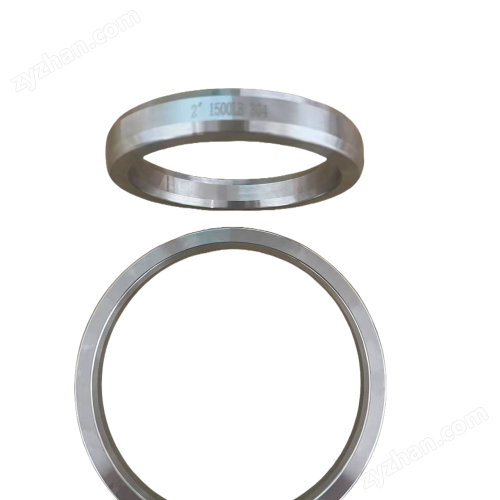
The temperature range of high-temperature and high-pressure 304 elliptical metal ring gasket octagonal gasket pipeline valves is generally from -200 ℃ to 800 ℃, and the pressure range is from 2.0 megapascals to 42 megapascals. They are suitable for flange sealing of high-temperature and high-pressure pipelines, such as pipe flanges for high-temperature and high-pressure steam, gas, solvents, tower troughs, pressure vessels, high-speed joint surfaces, high-temperature and high-pressure valves, covers, etc. They are also widely used in wellhead equipment and Christmas trees in the petroleum and natural gas industry.
High temperature and high pressure 304 elliptical metal ring gasket octagonal gasket pipeline valve
The correct installation of octagonal gaskets is the key to ensuring reliable sealing under high temperature and high pressure conditions. It is necessary to strictly follow the operating specifications and control the entire process from preparation before installation to final tightening. The following are detailed installation steps and precautions:
1、 Preparation work before installation
Match check between gasket and flange
Confirm that the material, specifications (side length, thickness, cross-sectional shape) of the octagonal gasket match the flange trapezoidal groove. For example, the nominal diameter of the gasket needs to be consistent with the flange, and the cross-sectional dimensions need to meet the design requirements of groove depth and width (usually based on standards such as ASME B16.20).
Check the angle (usually 23 ° or 30 °) and surface roughness (generally Ra3.2~6.3 μ m) of the flange trapezoidal groove to ensure that there are no defects such as dents, protrusions, cracks, etc. There should be no through scratches in the groove (otherwise it may become a leakage channel).
Clean and inspect the sealing surface
Clean the impurities on the flange groove and gasket surface, including oil stains, rust, welding slag, dust, etc. (can be wiped with a lint free cloth dipped in alcohol or special cleaning agent). If there are hard particles present, it can cause uneven local stress on the gasket, even leading to crushing.
Check the surface quality of the gasket: Ensure that there is no deformation, scratches, burrs, rust or cracks, and that the edges are not curled. Otherwise, replace the gasket with a new one (for reusable gaskets, confirm that the surface flatness has not been damaged).
Preparation of tools and auxiliary materials
Prepare a torque wrench (select range according to bolt specifications to ensure accuracy), bolt lubricant (such as high-temperature anti seize agent to avoid jamming or biting during bolt tightening), marking pen (mark bolt tightening sequence), etc.
2、 Placement and positioning of gaskets
Correctly insert the gasket
Place the octagonal gasket smoothly into the flange trapezoidal groove, ensuring that the gasket is fully aligned with the groove bottom and side without any tilt or offset. If the gasket is not placed correctly, it will cause a decrease in the local contact area, and it is easy to have excessive compression on one side and insufficient sealing pressure on the other side when tightening.
For horizontal flanges, the gasket can be slightly rotated to confirm that it can slide freely in the groove (without jamming), indicating that it is placed in place; For vertical flanges, temporary fixing of gaskets (such as using specialized fixtures) is required to prevent slipping during installation.
Avoid human damage
3、 Pre tightening and tightening of bolts
Preliminary pre tightening of bolts
When installing flange connection bolts, first apply lubricant to the bolt threads and nut contact surfaces (to avoid biting at high temperatures), then manually screw all bolts into the screw holes to ensure that the nuts are in contact with the flange surface and that the length of the bolt exposed from the nut is consistent (usually 2-3 threads).
Preliminary pre tightening purpose: to make the gasket make initial contact with the flange groove, eliminate the gap, and ensure that the pre tightening force of each bolt is uniform (can be manually tightened until it cannot be rotated).
Symmetrical and step-by-step tightening of bolts
-

High temperature and high pressure 304 elliptical metal ring gasket octagonal gasket pipeline valve
Tightening sequence: The principle of "symmetrical cross" must be adopted, which means tightening symmetrically from the center of the flange to both sides to avoid deformation of the flange caused by one-sided force. For example, for a flange with 4 bolts, follow the order of "1 → 3 → 2 → 4"; For multi bolt flanges, skip 1-2 bolts in a clockwise or counterclockwise direction and tighten them step by step (refer to the diagram below: number the bolts as 1, 2, 3... n, in the order of 1 → n/2+1 → 2 → n/2+2...).
Step by step loading: Gradually increase the torque to the design value in 3-4 steps, rather than tightening it all at once. For example, apply 50% of the design torque for the first time, 80% for the second time, and 100% for the third time, and check whether the gasket remains centered after each tightening.
Torque value control: Strictly tighten according to the torque value required by the flange design (refer to the torque table corresponding to the bolt material and specification), avoiding over tightening (causing excessive plastic deformation of the gasket, flange or bolt yielding) or over loosening (insufficient compression of the gasket, unable to form an effective sealing band).
Confirm the fit state after fastening
4、 Inspection and precautions after installation
Initial sealing inspection
Before boosting the system, an air tightness test can be conducted (such as introducing inert gas and checking for bubbling at the flange interface with soapy water) to confirm that there is no leakage.
If the system allows, cold tightening can be performed first (re tightening bolts in sequence at room temperature) to avoid a decrease in pre tightening force caused by thermal expansion and contraction of bolts under high temperature conditions.
Monitoring during operating conditions
After the system is started, closely monitor temperature and pressure changes. If there are fluctuations, it is necessary to check the bolt pre tightening force again after stabilization (especially under high temperature conditions, bolts may experience torque loss due to creep).
Do not disassemble or tighten bolts under system pressure to avoid gasket failure due to pressure impact.
Precautions for repeated use
If the gasket needs to be reused, it should be cleaned and the surface flatness checked to confirm that there is no plastic deformation (a ruler can be used to fit the surface, with a gap not exceeding 0.1mm); At the same time, check whether the flange groove has been worn due to previous installation, and repair the flange surface if necessary.
Summary of Key Principles
Clean, centered, and even ": The sealing surface must be clean, the gasket positioning must be precise, the bolt tightening force must be evenly distributed, and local overpressure or underpressure must be avoided.
Matching priority: The size, material, and adaptability of gaskets and flanges must be strictly matched, and gaskets of different specifications or materials cannot be mixed.
By following the above steps, the risk of leakage caused by improper installation can be minimized to ensure the long-term sealing reliability of the octagonal gasket in high temperature and high pressure environments.
The mismatch between gasket material and flange material is an important cause of sealing system failure, which may lead to a decrease in sealing performance, component damage, and even safety accidents. The specific consequences are as follows:
1、 Sealing failure resulting in leakage
Insufficient or uneven distribution of contact stress
The hardness and elastic modulus of different materials vary greatly. For example:
If the gasket material is too soft (such as pure copper) and the flange material is too hard (such as stainless steel), the gasket will be excessively compressed and embedded in the small pits on the flange surface during tightening, resulting in a decrease in the effective sealing contact area and easy leakage from the gap when the pressure rises;
If the gasket material is hard (such as hard alloy) and the flange material is soft (such as carbon steel), the gasket cannot fully adhere to the flange surface, and the contact stress is concentrated at local high points, forming a "point contact" rather than a "surface seal", which increases the risk of leakage.
Mismatched coefficient of thermal expansion leads to gaps
Under high temperature conditions, if the difference in thermal expansion coefficient between the gasket and the flange is too large (such as metal gasket and non-metal flange, different metal material combinations), the expansion and contraction of the two will not be synchronized when the temperature changes, which will damage the original sealing contact pressure and form a new leakage channel. For example, when the expansion of the gasket is greater than that of the flange, it may deform due to "excessive compression"; When the expansion amount is less than the flange, a gap will be generated due to "relaxation".
2、 Chemical reaction between materials, damaging the sealing surface
Electrochemical corrosion
When two metals with different electrode potentials come into contact (such as copper gaskets and carbon steel flanges), a primary battery reaction will occur in a humid or acidic electrolyte environment. The metal with a lower electrode potential (such as carbon steel) will corrode as the anode, producing rust and pits, resulting in damage to the flange sealing surface; At the same time, corrosion products (such as rust) may adhere to the surface of the gasket, damaging its flatness and further exacerbating leakage.
Chemical compatibility issues
If both the gasket and flange materials react with the medium, or if there is a chemical reaction between the two, it will directly damage the sealing components. For example:
When aluminum gaskets come into contact with brass flanges, intermetallic compound reactions may occur, generating brittle substances that can cause the gasket or flange surface to peel off;
In sulfur-containing media, the contact between stainless steel flanges and carbon steel gaskets may cause surface cracking due to the "sulfur embrittlement" reaction.
3、 Mechanical damage, shortened component lifespan
Plastic deformation of gaskets or flanges
When the material hardness does not match, the phenomenon of "hard damage and soft" may occur during the fastening process:
Hard gaskets (such as high chromium alloys) can scratch the sealing surface of soft flanges (such as aluminum alloys), forming scratch leakage channels;
Soft pads (such as lead) may "crush" due to excessive plastic deformation under the compression of hard flanges, losing their resilience and unable to compensate for changes in the sealing surface caused by system pressure or temperature fluctuations.
fatigue failure
Under alternating pressure or temperature conditions, mismatched material toughness and elasticity can lead to fatigue of gaskets or flanges due to repeated stress. For example, when a flange with strong rigidity (such as cast iron) is combined with a gasket with poor elasticity (such as asbestos rubber), the gasket cannot absorb the small deformation of the flange, and cracks or fractures may occur under long-term alternating stress.
4、 Security risks and economic losses
Accidents caused by medium leakage: If flammable, explosive, toxic and harmful media (such as natural gas, chemicals) are transported, the leakage may lead to fire, explosion or poisoning of personnel;
Equipment shutdown and increased maintenance costs: In case of leakage, emergency shutdown and maintenance are required to replace damaged gaskets and flanges, which may even affect the operation of the entire system, causing production interruption and economic losses;
The cumulative harm of long-term corrosion: Electrochemical or chemical corrosion can gradually expand the damage to the sealing surface, which may lead to a decrease in the strength of the flange or pipeline body, causing more serious rupture accidents.
summary
The matching core of gasket and flange materials lies in hardness adaptation, electrochemical compatibility, thermal expansion coordination, and chemical stability. In practical applications, it is necessary to select a matching material combination based on the properties of the medium (temperature, pressure, corrosiveness), working conditions, and relevant standards (such as ASME, GB) (for example, stainless steel flanges are often paired with metal clad gaskets, nickel based alloy gaskets, etc.) to avoid the above consequences.