-
E-mail
czbkgz@126.com
-
Phone
13776809887
-
Address
Zhenglu Town Industrial Development Zone, Changzhou City
Product Categories
Changzhou Baokang Drying Machinery Co., Ltd


Asphalt modifier rake dryer
NegotiableUpdate on 01/05
- Model
- Nature of the Manufacturer
- Producers
- Product Category
- Place of Origin
Overview
The asphalt modifier rake dryer has undergone targeted and adaptive improvements, resulting in multiple variant varieties. Improve the sealing mechanism to ensure effective and safe shaft sealing.
Product Details
Asphalt modifier rake dryer
working principle
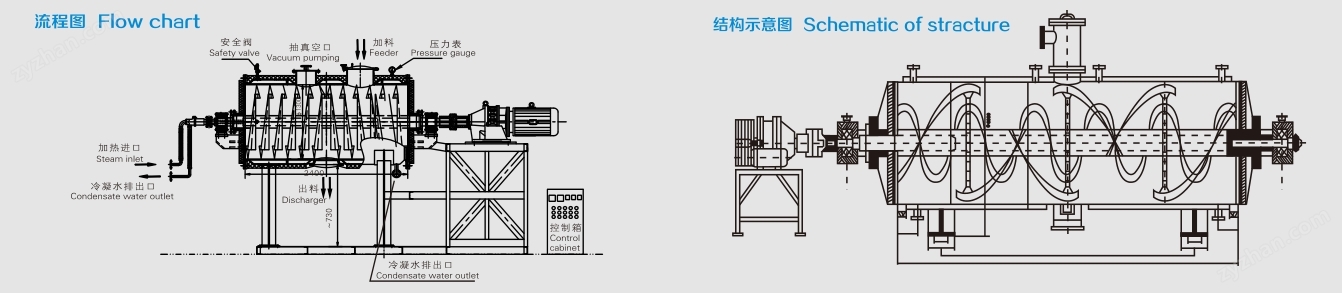
Asphalt modifier rake dryer, the object to be dried is added from the top of the shell in the middle. Under the continuous rotation of the rake teeth, the material moves back and forth in the axial direction, and the surface in contact with the inner wall of the shell is constantly updated. It is indirectly heated by steam, uniformly stirred by the rake teeth, and crushed by the crushing rod, making it easier to discharge the surface moisture of the material. The vaporized moisture is discharged from the vacuum pump outlet through the dry dust collector, wet dust collector, and condenser. Suitable materials for rake dryer: materials below 100 mesh, pigments, clay like materials, soda ash detergents, alkali stone starch, dyes and pigments, clay ash, etc.
Adopting the method of simultaneous heating with interlayer and internal stirring, the heat transfer surface is large and the thermal efficiency is high. Especially suitable for drying heat sensitive materials. The dried materials can be in the form of slurry, paste, granular, powder or fiber, and have been widely used in the production process of solid alcohol sodium. Mixing is set up to create a continuous circulation of materials inside the cylinder, further improving the uniformity of material heating.
Product Features
1. The device has a simple structure, small footprint, easy operation, and wide applicability.
2. Low equipment failure rate and easy to achieve fully automatic control of incoming and outgoing materials.
Scope of Application
The rake dryer is particularly suitable for drying heat sensitive materials, materials that are prone to oxidation at high temperatures, materials that are prone to hardening during drying, and materials that require the recovery of steam emitted during drying. After drying, the material is in powder form, so it is more suitable for finished products in powder form. After drying, it can be directly packaged without crushing. Drying of materials in industries such as medicine, food, and chemical: suitable for pulp, paste, and powder materials. Thermally sensitive materials that require low-temperature drying. Easily oxidizable, explosive, strongly irritating, and highly toxic materials. Require the recycling of materials containing organic solvents. The dried material can be in the form of slurry, paste, granular, powdery or fibrous, and has been widely used in the production process of solid sodium (potassium) alcoholate.
Mud like and high paste like materials: These materials usually have a high moisture content and are suitable for drying using a rake dryer.
Materials below 100 mesh: including various pigments, clay like materials, filter cakes, centrifuge filter cakes, soda ash detergents, alkali stone starch, dye pigments, clay ash, etc.
Thermally sensitive materials: Due to the use of interlayer and internal mixing for simultaneous heating in the rake dryer, the heat transfer area is large and the thermal efficiency is high, making it particularly suitable for drying thermosensitive materials.
Materials that are prone to oxidation, agglomeration, or require steam recovery: These materials are prone to oxidation or agglomeration at high temperatures, and rake dryers can effectively handle such materials.
Slurry, paste, granular, powdery or fibrous materials: The rake dryer is suitable for various forms of materials, including those commonly used in the production process of solid alcohol sodium.
Materials in industries such as pharmaceuticals, food, and chemicals: These industries often require drying under vacuum conditions, and rake dryers can meet these requirements.
Vacuum rake dryer is widely used in industries such as chemical, pharmaceutical, food, and feed. In the chemical industry, it is particularly suitable for drying heat sensitive materials such as dyes, pigments, dye intermediates, pharmaceutical raw materials, synthetic resins, etc.

Technical Reference
project |
model |
|||||||
name |
Unit Unit |
ZB-500 |
ZB-750 |
ZB-1000 |
ZB-1500 |
ZB-2000 |
ZB-3000 |
ZB-5000 |
Working volume |
L |
300 |
450 |
600 |
900 |
1200 |
1800 |
3000 |
Inner cylinder size |
mm |
Φ600x1500 |
Φ800x1500 |
Φ800x2000 |
Φ1000x2000 |
Φ1000x2600 |
Φ1200x2600 |
Φ1400x3400 |
stirring speed |
rpm |
5-25 |
5-12 |
5 |
||||
power |
kw |
4 |
5.5 |
5.5 |
7.5 |
11 |
18.5 |
22 |
Interlayer design pressure |
Mpa |
≤0.3 |
||||||
Pressure inside the cylinder |
Mpa |
-0.09~0.096 |
||||||
Note: The evaporation rate of water is related to the characteristics of the material and the temperature of the hot air inlet and outlet. When the outlet temperature is 90oC, the water evaporation curve is shown in the above figure (for selection reference). As the product is continuously updated, relevant parameters may change without prior notice.
Similar Product Recommend