-
Phone
1376488515213764885152
-
Address
Building 6, No. 1150 Lanfeng Road, Fengxian District, 4597
Product Categories
Shanghai Jintong Instrument Co., Ltd

Eclipse Ti-E/Ti-U/Ti SNikon research grade inverted biological microscope
NegotiableUpdate on 03/19
- Model
- Nature of the Manufacturer
- Producers
- Product Category
- Place of Origin
Overview
TIRF、 Focusing together FRET、 Photoactivation and microinjection techniques have helped scientists overcome many difficulties in imaging live cells. The core of all technology is Ti, and with this powerful new inverted microscope, you can easily use the above technology with the help of the Nikon CFI60 optical system. The Ti series has three models, and the improved system speed, enhanced flexibility, and efficient multi-mode characteristics make Ti an ideal system for research and live cell imaging. Nikon research grade inverted biological microscope
Product Details

TIRF、 Focusing together FRET、 Photoactivation and microinjection techniques have helped scientists overcome many difficulties in imaging live cells. The core of all technology is Ti, and with this powerful new inverted microscope, you can use it on the Nikon CFI60 ® With the help of optical systems, the above technology can be easily used. The Ti series has three models, and the improved system speed, enhanced flexibility, and efficient multi-mode characteristics make Ti an ideal system for research and live cell imaging.
Nikon research grade inverted biological microscope
High quality contrast images
The optical designer of Nikon inverted microscope Eclipse Ti-E/Ti-U/Ti-S has developed an external phase difference unit. By using this innovative system, the phase contrast ring is integrated into the microscope body instead of the objective lens. Users do not need to use a phase contrast objective lens to observe phase contrast images and can obtain high-quality images through a high numerical aperture objective lens. In addition, using an objective lens without a phase difference ring can obtain a "full brightness" fluorescence image.

Phase contrast ring placed inside the microscope body
The optical path design of placing the phase difference ring originally placed in the phase difference objective lens on the external phase difference unit of the microscope body facilitates users to obtain high-resolution phase difference images using a high numerical aperture objective lens. There are four types of phase difference rings to choose from based on the objective lens used (Ti-E/U/S universal).
ultra-high resolution
Using Nikon's high-performance objectives, including 60x and 100x TIRF objectives, with a numerical aperture of 1.49 and integrated aberration correction ring, high-resolution phase difference images of other standard phase difference objectives can be obtained.

The "full brightness" fluorescence image obtained using the same objective lens has no light loss caused by phase difference rings. In the same system, not only can phase difference observation be performed, but brighter "full brightness" fluorescence images, confocal images, and TIRF images can also be obtained.(Source: Chengguan Instrument)

Immerse the objective lens in water to observe phase difference images
By using an external phase difference unit, clear and high-resolution phase difference images can be obtained even with immersion lenses.
High resolution images for image analysis
Due to the use of the same objective lens for phase contrast imaging, TIRF observation, and DIC observation, the resulting images can be used for high-precision data processing and image analysis, such as defining cell contours in TIRF images.
Research on Support for Multi Port Hierarchical Structure
The Nikon inverted microscope Ti-e features a multi image port design with left, right, and bottom * ports, allowing for the connection of one camera to each port. In addition, the expansion space design of the layered structure can add a rear port, which facilitates users to use double-layer fluorescent filter block boxes and multiple cameras for image acquisition. *Ti-E/B and Ti-U/B combination optional bottom port(Source: Chengguan Instrument)

Rear port ensures multi camera shooting
The optional rear port design has expanded the image acquisition capability. Combined with the side port, two cameras can be used to capture dual channel images. For example, when there is an observation interval between fluorescent proteins in FRET (Foster Resonance Energy Transfer) and there is a significant difference in the intensity of CFP and YFP, high signal-to-noise ratio images can be obtained by adjusting the sensitivity of a single camera for comparison.

Hierarchical structure improves scalability
The layered structure adopted by Ti fully utilizes the advantages of infinite distance optical systems, and integrates PFS into the objective converter. Two optional components other than PFS can be introduced into the optical path through a spacer block, and this system can simultaneously use laser tweezers, photoactivation units, and epifluorescence devices. Each layer's electric fluorescent filter block box can be individually controlled.(Source: Chengguan Instrument)
Obtain multiple fluorescent dye images with better performance over a wider wavelength range
The Nikon inverted microscope Ti-U introduces an 870nm wavelength blocking device, allowing researchers to use near-infrared fluorescent dyes including Cy5.5. The optical properties in the ultraviolet to infrared range have been improved, and the number of available objective lenses has increased. Focus stability can be achieved in a wide range of applications, regardless of Ca in the ultraviolet range2+Concentration measurement is still using laser tweezers in the infrared range.

Extraordinary fast image acquisition
Perform three channel (dual channel fluorescence and phase difference) rapid photography on a 96 well plate, increasing the speed by more than 2 times.

Nikon's Perfect Focus System (PFS) eliminates focus drift
Focus drift is a major obstacle in time series observation. Nikon's PFS system corrects for focal drift that may occur during prolonged observation and medication administration. Even when using high magnification lenses or techniques such as TIRF, the focus can still be maintained. In addition, integrating PFS on the objective converter helps save space and does not limit the expandable layered structure of Ti. PFS adopts an efficient optical compensation system to perform real-time correction on the Z-axis plane. When PFS is not needed, it can be easily removed from the optical path.

The digital control hub significantly improves the speed of electric accessories
The newly developed digital control hub for Nikon's research grade inverted microscope Eclipse Ti-E/Ti-U/Ti-S significantly improves the overall operating speed by reducing communication time between components and increasing the speed of each accessory. PC control optimizes the electric components of Ti, shortening the response time from action commands to movement, thereby implementing high-speed control of the entire system. By adding intelligent firmware, the overall operation time of electric components is significantly reduced, for example, the total time required for continuous image acquisition of three channels (dual channel fluorescence and phase difference) is greatly shortened, reducing phototoxicity to cells.
High speed electric control and image acquisition
Nikon inverted microscope Ti-S synchronously controls several electric components, such as objective lens converter, fluorescent filter block, shutter, condenser converter, and stage, allowing researchers to conduct multidimensional electric experiments. Faster attachment movement and image acquisition shorten overall exposure time, reduce corresponding phototoxicity, and help researchers obtain more meaningful data.

Improve the speed of each electric component
The speed of operating and/or converting objective lenses, filter blocks, XY stages, and excitation/blocking filters has significantly increased, allowing researchers to focus on observation and image acquisition. The newly developed controller can record and replicate observation conditions, enabling the use of a mouse to control the stage. The entire microscope is like an extension of the researcher's eyes and hands.(Source: Chengguan Instrument)
Each observation method uses optimized optical techniques to obtain perfect images
Nikon's optimized optical technology provides multiple modes of observing specimens, presenting every detail of cells to researchers.
NomarskiDifferential Interference (DIC)
The balance between high contrast and high resolution is crucial for observing subtle structures. Nikon's DIC system can obtain high-resolution images even at low magnification. The new DIC slider (dry) offers two options: high resolution and high contrast. The filter block type DIC analyzer can be placed inside an electric filter block box, significantly reducing the switching time between DIC observation and fluorescence observation.
difference
CFI Plan Fluor ADH 100x (Oil) can be used for phase difference image observation. Compared with traditional phase contrast lenses, this objective reduces the halo of phase contrast images and enhances the contrast of the images.
dark field
High NA spotlights can be used for dark field observation. It is possible to observe particles for a long time and avoid photobleaching.
Huffman modulation phase difference (HMC) ®
The combination of HMC objective lens and HMC condenser lens components can obtain high contrast, halo free images similar to 3D, which can be applied to transparent samples cultured in plastic culture dishes.
A new objective lens developed for the Ti series
CFI S Plan Fluor ELWD/ELWDPhase contrast objective
The newly developed objective lens has high transparency for light in the wavelength range from near ultraviolet (Ca2+) to near-infrared, and has improved chromatic aberration correction. High quality color free images can be obtained in various lighting modes.
Plan Apochromat 20xobjective lens
The new 20x objective lens has been added to Nikon's proprietary VC objective lens series, with axial chromatic aberration correction up to 405nm, making it an ideal objective for confocal observation and photoactivation technology.
Improve operability
All buttons and control converters used for electric operation are designed to be very user-friendly, allowing researchers to focus on their research without being affected by microscope operations.

The operation buttons are located on both sides and in front of the microscope body
The switching of fluorescent filter blocks, objective lens conversion, Z-axis coarse/fine adjustment, PFS on/off control, and transmission illumination on/off control can all be quickly switched through the buttons located on the microscope body.(Source: Chengguan Instrument)

Newly developed human-machine controller
High speed electric XY stage and Z-axis can be controlled through a handle or human-machine controller.

VFD screen and operation buttons in front of the microscope body
The microscope status, including objective information, and the on/off status of PFS will be displayed on the VFD screen. Adjust.

PFSCompensation function
The compensation function of PFS is easy to control, and can be switched between coarse/fine adjustment with just one button.
Remote control panel and preset buttons
The Nikon inverted biological microscope Eclipse Ti-E/Ti-U/Ti-S can be operated through a remote control panel to confirm the current status of the microscope. Additionally, the observation conditions can be automatically switched through preset buttons. With just one button, you can switch from phase difference to fluorescence observation.
Original tilted design
Slightly tilting the front of the microscope body backwards reduces the distance between the operator's eye points and the specimen by about 40mm, enhancing operability.

Nikon inverted microscope Ti-ETechnical Specifications
port |
4 |
focusing |
Move up/down through the electric objective lens converter |
Intermediate doubling |
1.5x |
other |
Light intensity control; Light on/off switching, VFD in front of the body, controller control |
eyepiece tube |
TI-TD binocular tube D, TI-TS binocular tube S, TI-TERG human-machine learning tube |
Eyepiece tube base |
TI-T-B eyepiece tube base, TI-T-BPH eyepiece tube base F/PH w/side camera port, TI-T-BS eyepiece tube base w/side port |
eyepiece |
CFI 10x, 12.5x, 15x |
Illumination pillar |
TI-DS transmission illumination column 30W, TI-DH transmission illumination column 100W |
condenser |
ELWD spotlight, LWD spotlight, HMC spotlight, ELWD-S spotlight, high NA dry&oil spotlight, dark field spotlight, CLWD spotlight |
Nosepiece |
TI-ND6-E electric six hole DIC objective converter, TI-N6 six hole DIC objective converter, TI-ND6 six hole DIC objective converter, TI-ND6-PFS w/electric six hole DIC objective converter |
objective lens |
CFI60 objective lens |
stage |
TI-S-ER electric stage with encoder |
Electric function of the body |
Focus adjustment (coarse/medium/fine), port switching(Source: Chengguan Instrument) |
Falling fluorescence attachment |
Six hole fluorescent filter block converter, filter block with noise cancellation mechanism introduced |
Nomarski DIC |
Differential control: Senarmont method (by rotating the polarizer) |
Weight (approximately) |
Differential configuration: 41.5kg |
Energy consumption (large value) |
Complete set (including HUB-A and peripheral equipment): approximately 95W |
Nikon inverted microscope Ti-UTechnical Specifications
port |
4 |
focusing |
Move up/down through the objective lens converter |
Intermediate doubling |
1.5x |
eyepiece tube |
TI-TD binocular tube D, TI-TS binocular tube S, TI-TERG ergonomic tube |
Eyepiece tube base |
TI-T-B eyepiece tube base, TI-T-BPH eyepiece tube base F/PH w/side camera port, TI-T-BS eyepiece tube base w/side port |
eyepiece |
CFI 10x, 12.5x, 15x(Source: Chengguan Instrument) |
Illumination pillar |
TI-DS transmission illumination column 30W, TI-DH transmission illumination column 100W |
condenser |
ELWD spotlight, LWD spotlight, HMC spotlight, ELWD-S spotlight, high NA dry&oil spotlight, dark field spotlight, CLWD spotlight |
Nosepiece |
TI-ND6-E electric six hole DIC objective converter, TI-N6 six hole DIC objective converter, TI-ND6 six hole DIC objective converter, TI-ND6-PFS w/electric six hole DIC objective converter |
objective lens |
CFI60 objective lens |
stage |
TI-S-ER electric stage with encoder |
Falling fluorescence attachment |
Six hole fluorescent filter block converter, filter block with noise cancellation mechanism introduced |
Nomarski DIC |
Differential control: Senarmont method (by rotating the polarizer) |
Weight (approximately) |
Differential configuration: 38.5kg |
Energy consumption (large value) |
Complete set (including HUB-B and peripheral equipment): approximately 40W |
Nikon inverted microscope Ti-STechnical Specifications
port |
2 |
focusing |
Move up/down through the objective lens converter |
eyepiece tube |
TI-TD binocular tube D, TI-TS binocular tube S, TI-TERG ergonomic tube |
Eyepiece tube base |
TI-T-B eyepiece tube base, TI-T-BPH eyepiece tube base F/PH w/side camera port, TI-T-BS eyepiece tube base w/side port |
eyepiece |
CFI 10x, 12.5x, 15x |
Illumination pillar |
TI-DS transmission illumination column 30W, TI-DH transmission illumination column 100W(Source: Chengguan Instrument) |
concentrator |
ELWD spotlight, LWD spotlight, HMC spotlight, ELWD-S spotlight, high NA dry&oil spotlight, dark field spotlight, CLWD spotlight |
Nosepiece |
TI-ND6-E electric six hole DIC objective converter, TI-N6 six hole DIC objective converter, TI-ND6 six hole DIC objective converter, TI-ND6-PFS w/electric six hole DIC objective converter(Source: Chengguan Instrument) |
objective lens |
CFI60 objective lens |
stage |
TI-S-ER electric stage with encoder |
Falling fluorescence attachment |
Six hole fluorescent filter block converter, filter block with noise cancellation mechanism introduced |
Nomarski DIC system |
Differential control: Senarmont method (by rotating the polarizer) |
Weight (approximately) |
Differential configuration: 29.6kg |
Energy consumption (large value) |
Complete set (including HUB-B and peripheral equipment): approximately 40W
|
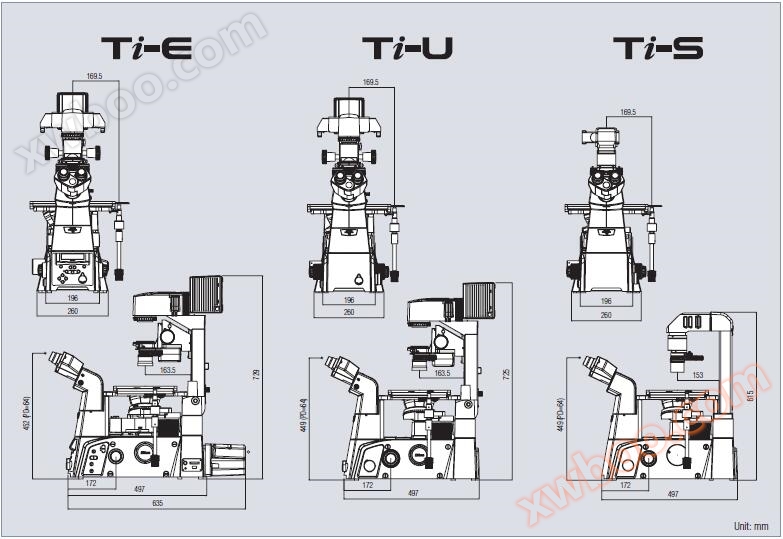
Nikon research grade inverted biological microscopeOverall dimensions:
Similar Product Recommend