-
E-mail
shouwang6368@126.com
-
Phone
18051034886
-
Address
No. 19, Tuanshan East Road, Lishui Economic Development Zone, Nanjing City
Product Categories
Nanjing Shouwang Machinery Equipment Co., Ltd
Ton bag unpacking station
NegotiableUpdate on 01/05
- Model
- Nature of the Manufacturer
- Producers
- Product Category
- Place of Origin
Overview
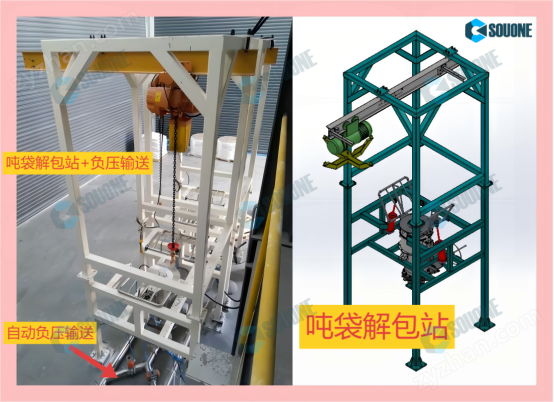
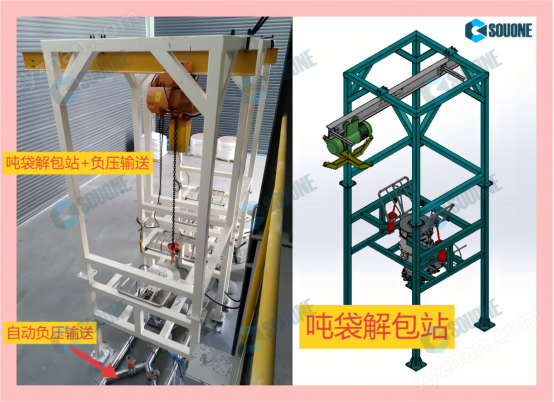
The ton bag unpacking station is a specialized equipment used to safely and efficiently unload and transport materials such as particles, powders, and small pieces inside ton bags to subsequent production processes. The working process needs to balance the three core objectives of material cleanliness, operational safety, and unloading efficiency.
Product Details
Ton bag unpacking stationIt is a specialized equipment used to safely and efficiently unload and transport particles, powders, small pieces, and other materials from ton bags to subsequent production processes. The working process needs to take into account the three core objectives of material cleanliness, operational safety, and unloading efficiency. The specific steps of the process include pre preparation, core unloading, post cleaning, and safety monitoring
1、 Pre preparation stage
Before starting the equipment, it is necessary to complete basic checks and material preparation to ensure smooth processes:
Equipment status check
Check whether the main structure of the unpacking station (such as frame, support platform, sealing cover) is stable, without looseness or deformation;
Confirm that the unloading system (such as screw conveyor, vibrating feeder, negative pressure suction pipe), dust removal system (pulse dust collector, fan), clamping/lifting device (cylinder, hydraulic rod) and other components are in normal standby state, without blockage, oil leakage/gas phenomenon;
Check that the electrical control system (PLC panel, emergency stop button, sensors) is displaying normally, and that the safety interlock devices (such as sealing door limit and bag clamp in place detection) are functioning effectively.
Material and ton bag preparation
Verify the name, specifications, and batch of materials in the ton bag to ensure consistency with production requirements;
Check the appearance of the ton bag for any damage or leakage, and ensure that the lifting straps are intact and not broken, in order to prevent material contamination or the ton bag from falling during unloading;
If the material is prone to moisture absorption and clumping, it is necessary to confirm in advance whether the unpacking station is equipped with a heating/arch breaking device and pre-set relevant parameters.
2、 Lifting and positioning of ton bags at the ton bag unpacking station
Accurately placing the ton bags at the unpacking station working position through lifting equipment is a prerequisite for safe unloading:
Ton bag lifting
Operate a crane, forklift, or electric hoist and hook the four lifting straps at the top of the ton bag with a hook (evenly stressed to avoid tilting on one side);
Slowly lift the ton bag and move it directly above the unpacking station, avoiding collision with the equipment frame or surrounding facilities during the process.
Positioning and fixing of ton bags
Slowly lower the ton bag onto the "ton bag support platform" or "bag clamping device" of the unpacking station, ensuring that the discharge port of the ton bag is facing the entrance of the "discharge funnel" of the unpacking station;
Activate the clamping device (pneumatic/hydraulic gripper) and secure it from the side or top of the ton bag to prevent it from shaking during unloading; Some unpacking stations will also use a "lifting device" to tighten the ton bags upwards, allowing the discharge port to naturally sag and facilitate subsequent bag opening.
3、 Sealing and dust removal start-up
To prevent material dust from escaping and polluting the environment, it is necessary to first establish a closed space and activate the dust removal system:
Sealing cover closed
Manually or automatically close the sealing cover of the unpacking station (usually made of transparent organic glass or steel plate material for easy observation of the internal situation), forming a closed area for the ton bag discharge port, discharge funnel, and dust removal suction port;
Confirm that the sealing cover is tightly attached to the frame without any obvious gaps, and adjust the sealing strip if necessary.
Dust removal system startup
By starting the pulse dust collector and induced draft fan through the PLC panel, a micro negative pressure is formed in the enclosed area (the negative pressure value is usually controlled at -50~-150Pa), ensuring that the dust generated during the unloading process is timely sucked into the dust removal system, filtered by the filter bag, and discharged in compliance with standards. The collected dust can be returned to the material system through the ash discharge valve for recycling.
4、 Opening and unloading of ton bags
This is the core process of the unpacking station, which requires selecting different bag opening methods based on material characteristics to ensure smooth unloading of materials
Open bag operation
Manual bag opening: The operator extends into the interior through the "glove operation hole" on the sealing cover, unties the binding rope (such as nylon rope, zip tie) at the discharge port of the ton bag, or cuts the seam of the opening to allow the material to fall naturally;
Automatic bag opening: If it is a fully automatic unpacking station, the equipment will automatically cut open the ton bag discharge port through a "cutting device" (such as a rotating blade, pneumatic scissors), or invert the ton bag through a "flipping device", with the assistance of a vibrator for unloading (suitable for materials with poor fluidity).
Material transportation
After the material falls from the discharge port of the ton bag into the discharge funnel below, it is uniformly transported to subsequent links (such as silos, mixers, production lines) through the "feeding device" at the bottom of the funnel (such as screw conveyors, vibrating feeders, star shaped discharge valves);
If the material is prone to bridging (clumping and blocking the funnel), the "vibrator" on the funnel wall can be activated to break the material arch and ensure continuous material discharge; Some unpacking stations will also install "stirring blades" inside the funnel to pre disperse the agglomerated materials.
Unloading monitoring
The operator monitors the unloading progress of the ton bag in real-time through the observation window or camera of the sealed cover. If excessive material residue is found (such as sticking material on the inner wall of the ton bag), the "tapping device" (pneumatic tapping plate) can be activated to lightly tap the outer wall of the ton bag to assist in material detachment;
After the material in the ton bag is basically unloaded, pause the feeding device and prepare for the next operation.
5、 Empty bag recycling and cleaning
After unloading, it is necessary to safely recycle empty bags and clean the interior of the equipment to avoid cross contamination of materials
空袋取出
Close the dust removal system, open the sealing cover, and loosen the clamping/lifting device;
Operate the lifting equipment to slowly lift the empty bag away from the unpacking station and transfer it to the empty bag collection area (if there is a small amount of material remaining in the empty bag, it can be cleaned by tapping in the designated area before recycling);
For the ton bags that need to be recycled and reused, they need to be cleaned and inspected (for the integrity of the sling and bag body), and stored after meeting the standards; For disposable ton bags, they should be classified and recycled according to the solid waste treatment standards.
Equipment cleaning
Clean the residual materials on the inner walls of the discharge funnel and feeding device with compressed air or a soft bristled brush to ensure no accumulation of materials;
If materials need to be replaced in subsequent production, the sealing cover, dust filter bag, conveying pipeline, etc. should be cleaned (such as water washing, negative pressure suction) to avoid cross contamination of different materials;
After cleaning, close the sealing cover, reset all components, and prepare for the next batch of ton bags to be unpacked.