-
E-mail
yue.li@ametek.com
-
Phone
15221486284
-
Address
A1 and A4, 2nd Floor, Building 1, No. 526 Fute East 3rd Road, Shanghai Pilot Free Trade Zone
Product Categories
Ametec Trading (Shanghai) Co., Ltd

Water vapor permeation analyzer
NegotiableUpdate on 01/04
- Model
- Nature of the Manufacturer
- Producers
- Product Category
- Place of Origin
Overview
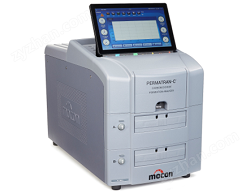
PERMATRAN-W® 101K is a specially designed WVTR (or MVTR) instrument used to test breathable or high emitter barriers. It is a water vapor permeation analyzer that tests breathable membranes and complies with ASTM D6701 battery testing system
Product Details
Water vapor permeation analyzer
PERMATRAN-W ® 101K is a 6-unit instrument that allows you to test up to 6 samples simultaneously under the same conditions. The unique design allows for accurate and realistic penetration measurements of samples that reflect the true situation.
high precision
Unique RH control allows for repeated ASTM D6701 testing
Measure the transmission rate of water vapor or water vapor through porous and breathable polymer films, polymer coated thin papers, and thin polymer nonwoven fabrics.
Measuring up to 101000 g/(m)2 *The WVTR of the advanced transmitter of Tian
Accurate temperature measurement and control
High throughput
Test breathable film, coated paper, etc
The unique testing method is faster and more accurate than the weight analysis method
Parallel testing of 6 samples at once
PERMATRAN-W 101K is designed to effectively and accurately test the water vapor transmission rate (WVTR or MVTR) on breathable barriers. The use of traditional weight analysis methods to test highly permeable materials can be affected by driving force issues caused by air gaps, resulting in inconsistent and erroneous test results. The 101K WVTR analyzer adopts an improved inverted water cup concept, eliminating air gap issues and maintaining a constant 100% RH throughout the entire testing period, providing accurate and reproducible results. This analyzer is designed specifically for high emission barriers and can provide 500 to 101000 g/(m)2 *The test results of the instrument meet the ASMT D6701 standard specifically designed for this instrument method.
This instrument has an easy-to-use operator interface and can be connected to other MOCON instruments, providing centralized control and monitoring of multiple instruments. It has adjustable temperature control and flow and pressure correction functions.
For 25 years, MOCON's PERMATRAN series instruments have been the most trusted and longest lived instruments on the market. 101K provides accurate measurement of water vapor permeability for breathable barriers that are difficult to test using other methods.
Features and Advantages
High throughput
Integrated 6-unit test head, capable of testing 6 samples simultaneously in parallel
The compact test chamber area is easy to load
All 6 cells have consistent testing conditions
Single clamp provides reproducible results
Simple user interface
Overview: The dashboard screen provides a clear overview of the status of all cells at a glance
The automatically generated test report contains complete test data and conditions for all 6 cells
It is possible to connect a control system to other MOCON instruments for centralized monitoring and control of multiple instruments
Innovative RH control
Throughout the entire testing process, relative to the gravity tester, RH maintained a humidity of 100%
No need for voltage division for analysis
Real measurement of WVTR through porosity, permeability, and diffusivity<
warranty
Complete 100% parts and process warranty for 12 months
Function - All models
PERMATRAN-W 101K WVTR Analyzer |
unit |
Temperature control range |
20 °C to 50 °C ± 0.5 °C |
Humidity control, thin-film battery, testing gas |
100% |
Test scope, film, unshielded (10 cm2) |
500 to 100,000 g/(m2 • day) |
Resolution, film |
1.0 g/(m2 • day) |
Repeatability, film |
1% |
Physical specifications
15.5” H x 12” W x 23” D (39.4 cm x 30.4 cm x 58.0 cm)
95 Lbs. (43.1 kg)
Electrical requirements
Voltage: 100-240 VAC 50/60 Hz
Maximum power consumption: 700 VA
Laboratory requirements
temperature |
Operation method |
22 °C ± 2 °C |
storage |
10 °C to 30 °C |
|
humidity |
Operation method |
20% to 80% RH (non condensing) |
storage |
5% to 85% RH (non condensing) |
Gas supply requirements
carrier gas |
gas composition |
Nitrogen (99.99% N2 or higher) |
Supply pressure, nominal |
29 PSI, (2.0 Bar), (200 kPa) |
connectivity
Dual RS-485 ports (one for input from other instruments and one for output to a computer)
application
special materials
bandage
Commonly used non-woven materials:
Masks (may contain meltblown polypropylene)
Medical personal protective equipment
baby diapers
Adult diapers
Women's Protection
Porous and breathable polymer membranes are commonly used for:
Construction packaging
Battery separation
filter
Thin paper with polymer coating
Meets testing standards
ASTM D6701
test method
belowASTM D6701
Standard testing methods determine the water vapor transmission rate through non-woven and plastic barriers
Summary of Testing Methods
The dry chamber, protective film, and wet chamber form a diffusion pool, in which the test film is sealed. Firstly, test the water vapor transmission rate of the protective film and the air gap between the evaporator components that generate 100% relative humidity. Sensors generate electrical signals whose amplitude is proportional to the concentration of water vapor. The electrical signal is routed to the computer for processing. The computer calculates the transmittance of the air gap and protective film, and stores this value for future use. Then seal the barrier in the testing unit and start the equipment in testing mode. As mentioned earlier, the electrical signal representing water vapor is sent to the computer, which then calculates the transmittance of the combination of the air gap, protective film, and test barrier. Then, the computer uses this information to calculate the water vapor transmission rate of the tested material. The computer determines when the measurement results indicate that the sample has reached equilibrium and considers the test to be completed.
Water vapor permeation analyzer